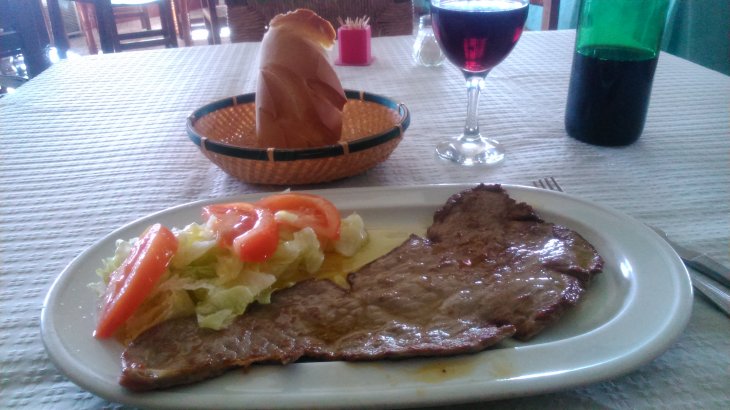
Camino de Santiago – Via de la Plata (Salamanca-Calzada de Valdunciel-El Cubo de Vino 34 Kilometres)

DSC_0027

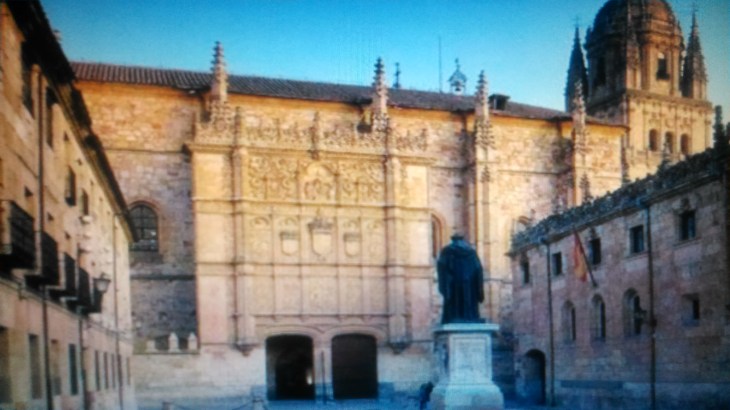
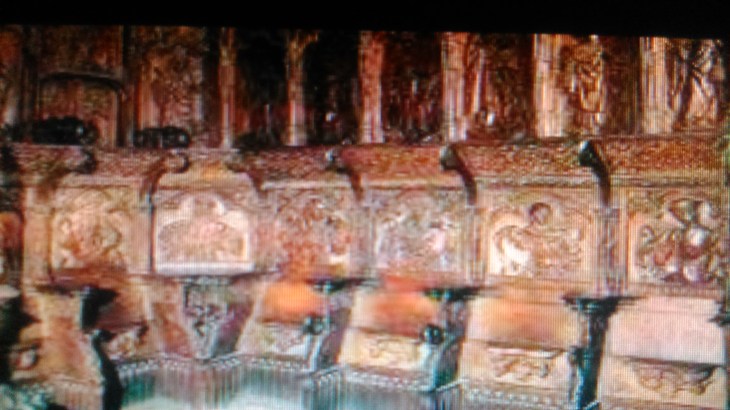
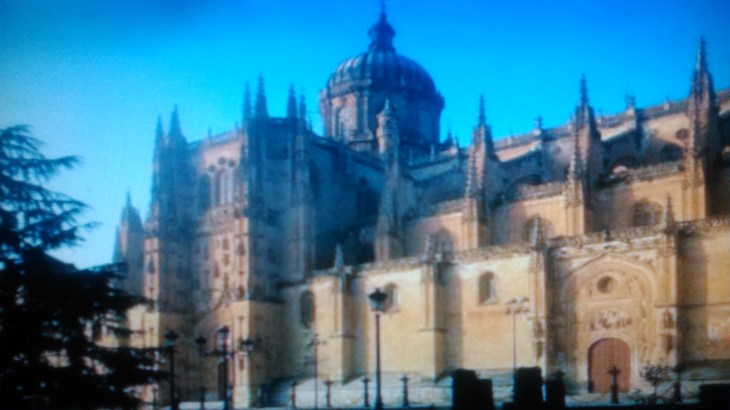
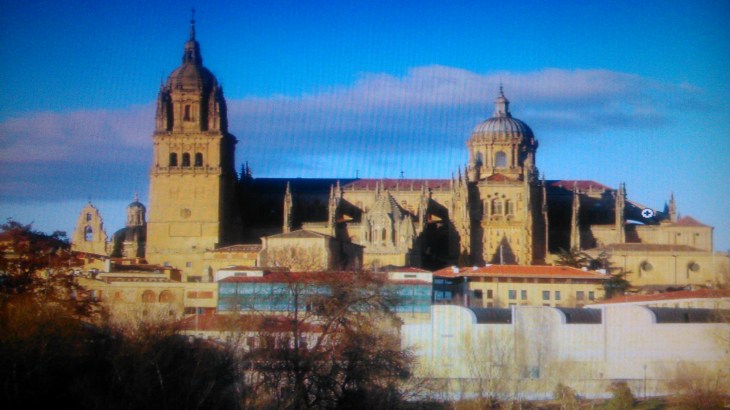
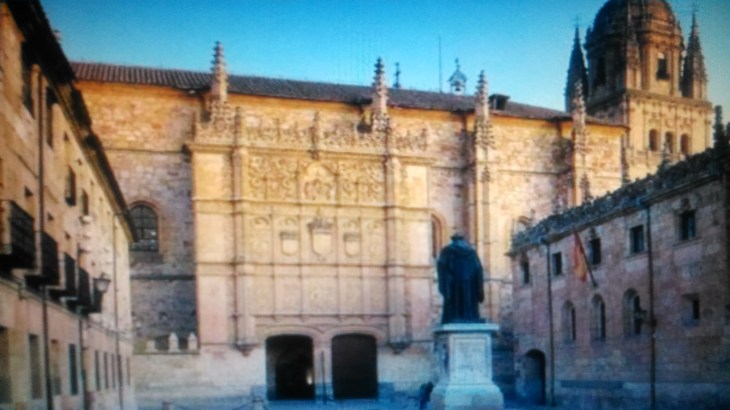
Salamanca is a beautiful city, and Victor and I examined every nook and cranny. However, he was convinced that there was a darker side to the city. Both the Templars and the Nazis,  showed a keen interest in the caves behind the city, but inspite of Victor’s efforts on line, we didn’t have time to investigate. He was equally convinced,  that the city and it’s churches were built on a huge line of energy, well known to ancient people. He frequently threw himself down in front of the altars, to communicate with Gaia (the mother goddess) , and feel the pulse of the world.

DSC_0025

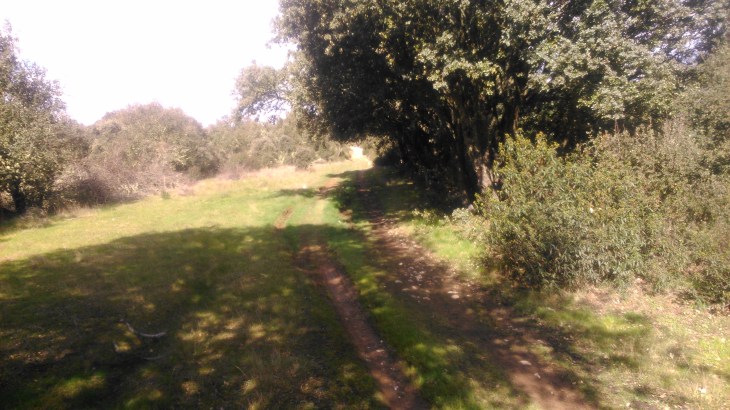
We had a.good walk, well signposted, to El Cubo de Vino.  We cooked lunch outside,  had a siesta and arrived late. In the alberge,we ate with the family and then chatted and watched television with them until bedtime, in front of a roaring fire. It was freezing outside, we were on the maeseta.


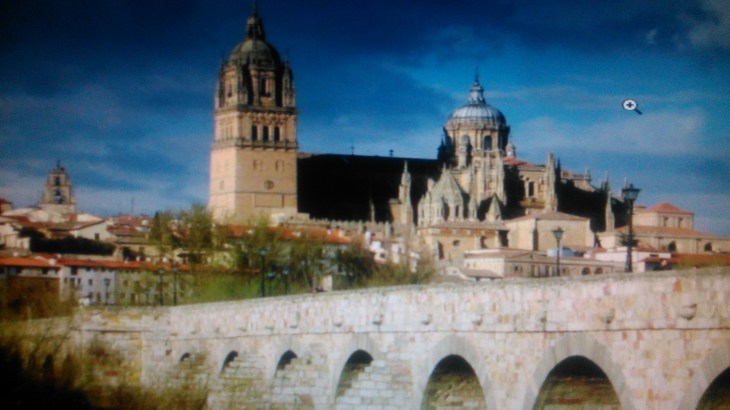
The Road to Salamanca


DSC_0024The walk into Salamanca from the surrounding hills, must be one of the most beautiful parts of this Camino. The alberge is near the cathedral, it is large, comfortable, and very well organised.

DSC_0026

As soon as we had settled in, we made for the Taberna Celta, on the advice of Gerald Kelly, in his excellent guide , the Via de Plata.  We received a very warm welcome, and were plied with, not only free food and drink, but also tales of the Camino, for most of the afternoon, by the owner, Caesar,  and his friends.

Caesar told us that at the last ice age many people came to the Iberian Peninsula in advance of the ice, bringing with them their ancient knowledge. The first caminos were made by the Celtiberians, along ley lines or lines of energy,  to Finisterra, to worship the sun, at the end of the world (Finisterra) .

IMG_20160322_180417

He invited us back next evening to savour ‘chorizo del enfierno ‘, washed down with aguardiemte.


Camino de Santiago – Via de la Plata (Fuenterroble to San Pedro de Rozados 26 Kilometers)

DSC_0075

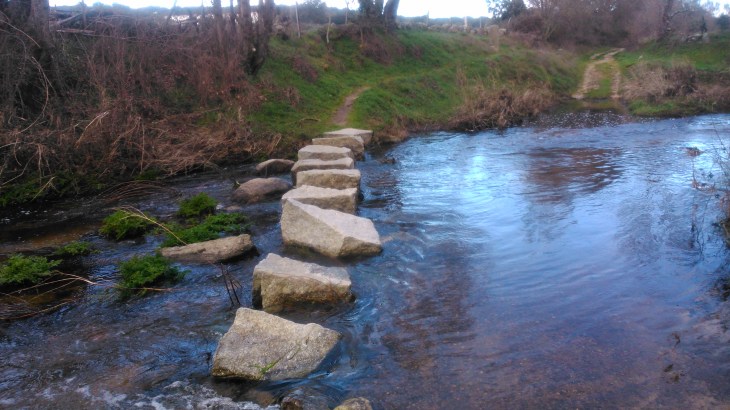
This is a beautiful but long stretch,  along the Roman road,  through the mountains and then, along quiet country roads to San Pedro.  You need food, water,  warm clothes for the morning, and sunscreen for the afternoon. There are rivers to cross.

IMG_20160311_194618

Tomás

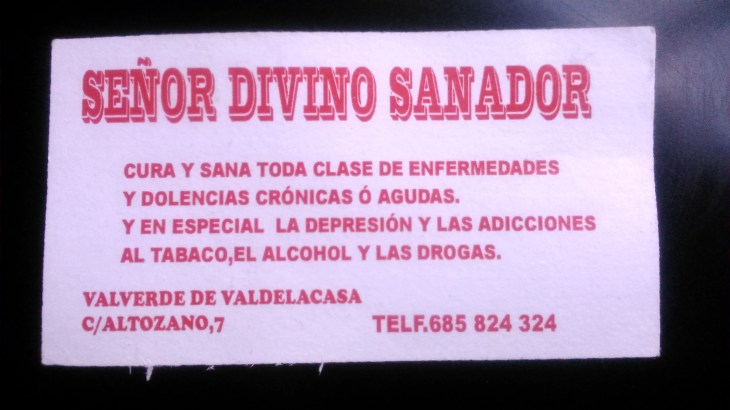
I’m not sure if it was the healing hands of Tomás,  the ‘Divine Cleaner ‘,  ‘El Divino Sanador’ or a good night’s sleep,  but I was full of energy and flew along.

DSC_0001

Tomás told me that I would get, not what I wanted,  but what I most needed.  This must be it!

I stayed with Mari Carmen at the VII Carreras Restaurant.  Mari Carmen owns all the alberges, so there is little choice. However,  she was very friendly and I had an excellent night.


Fuenterroble and a Conversation with a Madman

To reach I had heard a lot about Padre Blas, the ‘Spirit of the Via de la Plata’ , and was determined to call and speak to him, in the alberge in Fuenterroble.  When I reached the alberge, it appeared to be deserted, although there was a huge log fire burning in the grate, in what I assumed was , the Padre’s study.

I called out, and a figure appeared from the gloom.  This was Manolo, the hospitalario, who immediately launched into a monologue concerning his antecedents.  I had no idea at the time, but this is a normal introduction for men from small, isolated villages in Spain.  I assumed he was insane.  Manolo had something important to tell me about the camino, but he had to come at it from the distance of several generations.  Padre Blas, on the other hand was taciturn.  He was an old man now, and maybe, the ‘Spirit of the Camino’ had said all he needed to say, or, maybe, like Manolo, he realized that I wasn’t ready for more.

IMG_20160313_180520

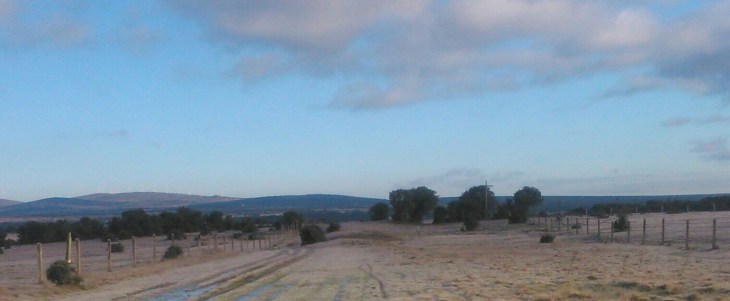
I left early the next morning to tackle ‘ El Pico de La Dueña.  It was freezing cold, with a bitter north wind.  There was nothing but 26 kilometers of Roman road between Fuenterroble and the next village, San Pedro de Rozados.


Camino de Santiago-Via de La Plata (Calzada de Béjar-Fuenterroble de Salvatierra)

It was going to be a short one today, before I tackled the top of the Pico de La Dueña, tomorrow. There was frost on the ground when I left Calzada, but it soon warmed up and turned into a very pleasant walk, although there were a few rivers to cross. The route is very well marked and, after 9 kilometers, I reached the village of Valverde de Valdelacasa. It was here that I met Tomás. The. first of my two strange encounters that day.

Tomás calls himself “Señor Divino Sanador”, he claimes that he can cure any and all classes of ailment or addiction, by the simple laying on of hands. He has had the power from a boy, and believes it comes from the Virgin Mary. I told him that I didn’t have particular problems at that point in time, but he insisted on giving me a short holding hands session, as a power boost. I have to confess, that I didn’t feel much difference but then I am a confirmed atheist and it may not work for everybody. He gave me his business card, told me to call anytime day or night, and that he could operate just as well over the phone. I thanked him very much and walked around the corner to find that the bar was closed. I was tempted to call, but I walked on to the next village, where I found an open bar with good food.

The lady in the bar turned on the television for me. These days, the 24 hour news shows harrowing pictures of the immigrants. A little boy died on a beach last night, so Spain has decided to take in 16,000 more people. Every afternoon, there is the endless interrogation of the Infanta (daughter of the last king and sister to the present one) and her husband over an enormous financial scandal. She looks tired and depressed, he, very handsome, but looks as guilty as a fox in a chicken coop. The politicans, still can’t form a government, even though the elections were back in December.

Camino de Santiago-Via de Plata (Aldeanueva del Camino-Calzada de Béjar 23 Kilometers)

DSC_0074

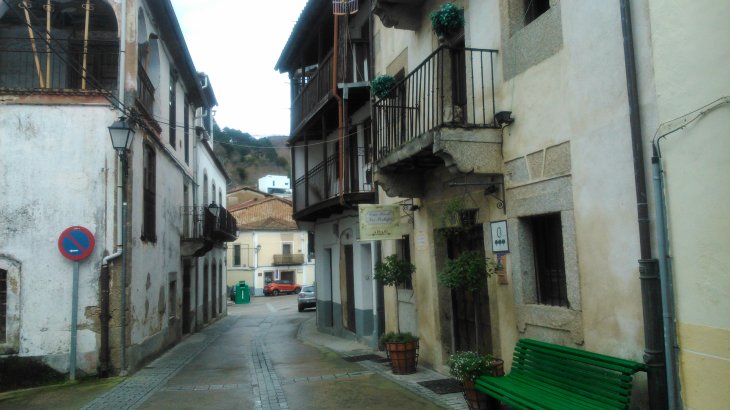
I left Aldeanueva and headed for the beautiful hill-top village of Hervás.  It is well worth a visit.  It has one of the best-preserved Jewish quarters in Spain, a tangle of narrow streets clinging to the mountainside ( what happened to the Jews? – don’t ask).
DSC_0062

From Hervás, you can walk directly to Baños de Montemayor without retracing your steps.  I followed the road signs and then picked up the camino arrows.  Baños is an ancient, little higgledy piggledy, village, boasting Roman baths (now a fashionable spa) and many 17th and 18th century houses.  I called into the bar in the square.  It was an older clientele, but after I had enjoyed my beer and tortilla ( energy food), they were happy to show me the way to the Camino and the Roman road.
DSC_0064

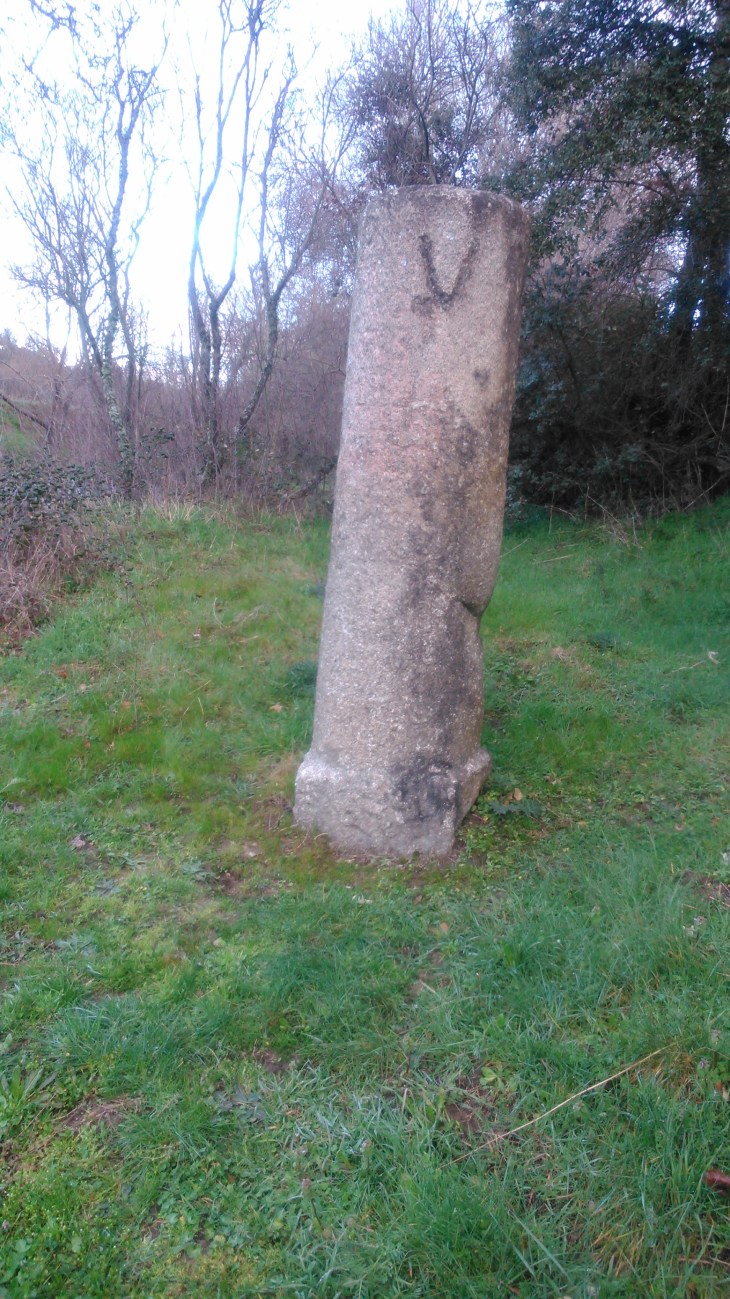
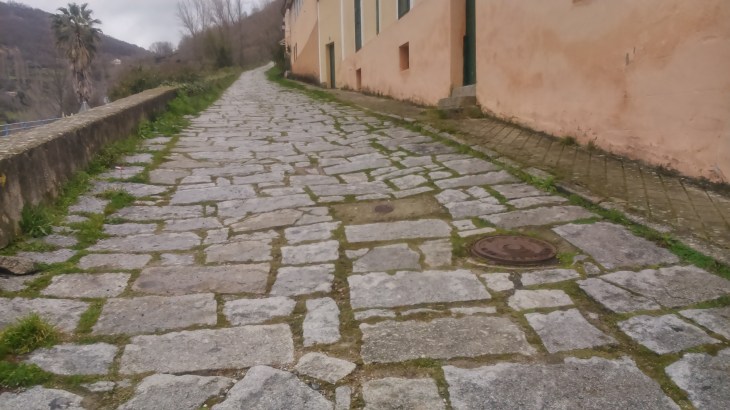
The route to Calzada follows exactly the Roman road, and is well signposted by not only the camino arrows but also the Roman stone pillars, every 1000 paces, their inscriptions sadly now illegible.


In meanders through countryside which must have been, once upon a time, well populated, but now neglected.  I passed huge moss-covered stone walls, enormous crumbling farmhouses and great bridges, nowadays, going nowhere. This was the work of generations, now returning to nature.  It is a little sad, but serves to remind us that live is short and should be sweet – carpe diem!

Calzada de Béjar has to be seen to be believed.  It is an ancient community of 80 souls, in the middle of the mountains, but on the Roman road, it runs down the main street.  There are now a few choices for accommodation.  I stayed at Casa Rural Jorge, which is well signposted, and I can only describe it as excellent.  Ester, the daughter of Jorge, settled me in and told me something of the history of the village.  As she was leaving, I pointed out that the horseshoes hanging over the fireplace were the wrong way around, and that the luck was running out. She disappeared,  returned with a claw hammer, and had the problem sorted in seconds. She apologised, said that she was not as superstitious as her granny, but some things could not wait until tomorrow.  I eat in the bar, 20 metres away, and slept very well.
Camino de Santiago – Via de La Plata(Oliva de Plasencia-Aldeanueva del Camino)

DSC_0047

I spent the night in a lovely little village called Oliva de Plasencia. This was on the advice of Gerald Kelly, in his guide “La Via de Plata” and it was excellent advice.  A lady called Anna showed me around the albergue.  It is an old house in the village, but with all mod cons, modern kitchen and bathrooms and everything else very comfortable.  Anna then opened the small supermarket, so that I could shop for dinner and breakfast.

I left early the next morning, and this is where things got tricky.  Gerald Kelly advises that there are several rivers to cross between Oliva and Aldeanueva.  I was walking with two Spanish friends, Antonio and José.  We visited the impressive remains of the Roman city of Cáparra and then tackled the rivers.

DSC_0052

They are substantial and one, we waded across chest deep.  However, it was a warm day and we soon dried off.  We three, of course, thought that this was great craic but these river crossing should not be attempted without local advice and never alone.

We followed the Camino arrows and reached the tarmac road.  After 3 kilometres on the road, we reached the motorway bridge and saw signs for Restaurant La Parilla.  La Parilla turned our to be a gem.  It is an old world Spanish restaurant, at one time in the country, but now consumed by an industrial estate and a tangle of flyovers.  From the look,  I thought that it had gone out of business about thirty years ago, but the owner and headwaiter, came to the door and swept us in with his apron.  He was not a young man and not a thin one.  He recited the menu, as he arranged the table, with a slight pause at the dish he would like us to order.  We all passed and had a wonderful meal.

DSC_0058

I enquired how far it was to Aldeanueva, on the Camino. At the mention camino, he rolled his lugubrious eyes heavenward.  It was obvious from his figure that he was not inclined to take exta long walks simply to admire the beauties of nature.  He held up four fingers, and uttered the words,  Via National, we were in Aldeanueva in no time.  I had intended to continue to the mountain village of Hervás, but the albergue there was closed so we spent the night in the Montesol roadhouse in Aldeanueva.


Camino de Santiago- Via de Plata ( Ríolobo-Oliva de Plasencia-41 kilometers)


DSC_0051I had no intention of walking so far, but it turned out to be an amazing day, one of the best so far, but that’s the Camino for you.  I had a great breakfast in ” Las Cantalinas”. It was raining and looked pretty miserable. Everyone helped to wrap me in my poncho until I looked like an onion- onions are watertight in Spain.  I was a very happy onion and waved goodbye, with advice to turn right back to the old Camino. In less than 100 metres, I met a local who was determined that I should turn around and walk in the opposite direction, to the other side of the village, and take the road and the new Camino to Galisteo.  The weather was looking worse, I had doubts about the old Camino, and I took his advice. I walked through the village to the far side from ” Las Catalinas”,  picked up the camino arrows at a petrol station, and followed them to Galisteo.

IMG_20160307_105122

Galisteo is a knockout, a perfect walled town.  Apart from a few stragglers outside, everyone lives within the walls.

DSC_0039

In the Plaza Mayor, in the bar beside the Casa Constitutional,  I had a coffee and a gorgeous slice of tortilla Española for 1€.10. Virginia, the German girl, was still way ahead of me, but she had dropped both her scarf and her pilgrim passport, and had asked me to keep an eye out for them.  I called into the Albergue to enquire , and I also asked after Victor, the lanky French man. Having described Victor, I got a wagging finger and those dead Spanish eyes.  Victor’s bad boy reputation had reached Galisteo.

DSC_0040

The route to Carcaboso, isn’t well marked but it is across the bridge built in 1534 and then onto the main road. Follow the road signs through the roundabouts and you will come to a very quiet road leading you all the way to Carcaboso.

In Carcaboso, head for the bar in the main street and you will get very friendly advice on both where to stay and how to leave and find the Camino again.To find the Camino and prepare for one of the most beautiful walks of your life,  cross the main street from the bar, walk up the street with the Farmacia shop, this will lead you to the plaza, cross the plaza and as you start to descend you will see the Camino arrows.  Strap in for a fantastic walk.

DSC_0043

Camino de Santiago- Via de Plata (Embalse de Alcántara-Cañavera-Grimaldol-Ríolobos)

DSC_0026

I made an early start in Embalse. However, when I entered the bar, in search of breakfast, all was in darkness.  I was happy to leave and eat en route but, just as I was about to open the door, a dark shape moved towards me from behind the bar and said, “¡Qué frio!”( How cold!), in shrill Spanish with a heavy French accent.  It was Madame, the lady of the house.  She was dressed in her usual sober colours, but in addition she was huddled in a black shawl, covering head, face and shoulders, to protect her from the morning chill.

She produced an excellent breakfast, coffee, toast, ham, cheese etc.  Normally, they give you too much and you can carry off enough for elevenses, it is expected. But, I got the impression that madame was keeping a weather eye on her comestibles from the depth of her shawl and I left with just what I could eat.

The Camino starts again, directly opposite the gate of the hostal and after a short scramble, I was back on the Roman road, with Cañaveral in sight and beautiful views of the reservoir behind.

DSC_0028

I reached Cañaveral in record time and found a small bar which served coffee and churros, a Sunday morning delight in Spain.

DSC_0031

A churro is a fried-dough pastry ( delicious!).

DSC_0030

The Camino follows the main road through town but then turns left onto a mountain track.  Just be careful here, there are several local signs, only follow the camino yellow arrows.

DSC_0035

This is a beautiful forested section and it is well signposted to Grimaldo.  Grimaldo is a small village, it has a bar and a Casa Rural ( equivalent to a bed and breakfast) called La Posada de Grimaldo which looks very well kept.  Grimaldo is not on the Camino, so to continue, you must retrace your steps to where you turned off at the motorway bridge. The Camino then continues through open farmland and runs parallel, but not close to, the motorway.

In 2012 the route of the Camino was changed to pass through the village of Ríolobos and avoid a right-of-way dispute. The new route is very well signposted and excellent accommodation is available in Ríolobos at the Camping Las Catalinas, dinner, bed and breakfast for €24.

.

Camino de Santiago-Via de Plata (Cáceres to Embalse de Alcántara 31 Kilometers)

I left Cáceres before eight this morning, and made my first stop at Casar de Cáceres, after 10 kilometers.  This is not only the first stop, but the last.  It is well worth stocking up with food and water at the supermarket, “El Barato”, in the main street, for the next 21 kilometers.

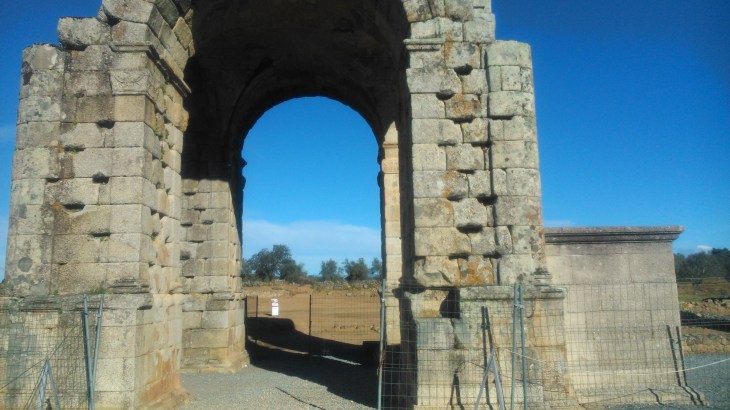
This is a beautiful walk on an old Roman road.  It passes through open farmland, with amazing views all around.  Even in the remotest parts of the walk , there are plenty of reminders of the well organized Roman system, pillars  carved with numerals and information, and little way stations, now mostly tumbled down, but at regular intervals.

The weather was perfect, and it was very easy to follow the yellow camino arrows but I found it a hard walk, especially the last 5 kilometers, along the main road.

Unfortunately the municipal hostal in Embalse de Alcántara is closed for renovations.  It has an amazing situation overlooking the “embalse”. This is a massive reservoir, made to supply much of Extremadura.  Many buildings, including churches disappeared under the waves in its making, however, with global warming, and the current water shortage, many are making a reappearance.,

Tonight, I am staying at the Alcántara, Pesca, Evasión. It’s a sort of guest house, run by a French couple, just on the main road where you turn down to the, now closed, Albergue Municipal.  At 30€ for bed, breakfast, and dinner, I think it is good value.