Camino de Santiago-Via de Plata (Valdesalor to Cáceres, 11 Kilometres)

After a great nights sleep, I left Valdesalor at first light, to spend a full day in Cáceres.  The camino is well marked, it hugs the main road for about 5 kilometres, but then, for another 5, takes a more direct route into the city, along the Roman road.


DSC_0014

I am using Gerald Kelly’s excellent book “Walking Guide to the Via de la Plata and the Camino Sanabres” and he recommends the Albergue Las Veletas, for good, inexpensive, accommodation.  To find it, I went straight ahead, climbing up through the city, through the main roundabout and finally turning right at the top of the hill into the Plaza San Juan, through the Plaza Mayor and left into Calle General Margallo.  The hostal is number 36.  It was full when I arrived, but the lady, very kindly, phoned all her contacts, until she got me a place, as it happened, in the next street with MariCarmen.  It was clean, very comfortable and 15€, including breakfast.

DSC_0015

Cáceres is a wonderful city, dripping with character and history.  My images don’t do it justice at all. The weather became cold and grey and overcast, in the afternoon. However,  I did visit the Museum of Cáceres and found rooms full of large stones, all with very familiar circular designs, all found locally.  The Celts have been here!!

IMG_20160304_181242

DSC_0016

Camino de Santiago-Via de Plata (Alcuéscar to Valdesalor 27 Kilometres)

Virginia  and I had breakfast together, and a friend of hers, originally from Venezuela, joined us.  He is now living in Madrid and he had driven up, to walk the Camino, with Virginia , for a couple of days.  At breakfast, there was some talk of a tall, lanky, young French guy, called Victor.  He is bumming his way around the caminos and the monks had not been at all keen to let him stay for free, or at all.  However, he had managed to inveigle his way in, but, strangly enough,Virginia could not remember meeting him, the night before.

IMG_20160304_181047

I let the two friends go ahead and we said our goodbyes, with promises to keep in touch.  The way was well signposted with camino arrows, and I had a wonderful day’s walking, under clear blue skies, along the Roman road, with the original bridges still intact,

DSC_0013

first to Aldea del Cano and then Valdesalor.

In Valdesalor, I got the key to the albergue municipal, from a very friendly lady in the bar, in the square, and shortly after, settled in to do my washing and relax.  I was later joined by Benito (Bene), a fellow pilgrim, who had stayed in the monastery the previous evening.  I was just about to leave for a tour of town (ten minutes walking slowly), when a loud knock came to the door and it was none other than Victor, all smiling teeth and dreadlocks.  He was hoping to gain direct entry, hence circumventing the need of going to the bar and paying the fee of 6€.  I had no problem with this proposal, but Bene, a middle aged Spaniard from Huelva, could not countenance it at all.  However, he managed to deal with his animosity by refusing to acknowledge the fact that Victor was there.  I left Victor, ransacking the kitchen cupboards in search of the ingredients for dinner, and went back to the bar.  He joined me there later and we had an excellent evening.


Camino de Santiago – Via de Plata (Mérida-Aljucén-Alcuéscar 34 Kilometres)

DSC_0005

I started walking the camino, the Via de Plata, again, in Mérida, on Wednesday 2nd of March and I hope to reach Santiago de Compostela on or before the 31st.  The weather in Extremadura is perfect for walking, cold first thing in the morning, but bright and sunny for the rest of the day.

DSC_0006

It is straight forward to find your way out of Mérida, simply follow the yellow camino arrows from the municipal hostel.  They will take you north, out of town, past the remains of the Roman aqueduct, and onward to the beautiful reservoir, Embalse de Proserpina.  This is now a resort and a nature reserve.  However, originally, it was built by the Romans to supply water to Emerita Augusta (Mérida), via the aqueduct.  The camino runs alongside the lake for a short distance and then turns unto a very rough tarmac road.  After about 2.5 kilometers, there is a sharp turn to the left, unto an unsurfaced track.  From here, the route is well signposted to Aljucén (15 kilometres) and then, Alcuéscar (19 kilometres).

It was at the point, where the route turns sharp left, that I met a German girl call Virginia.  We spent the rest of the day together, walking through olive groves, on old dusty tracks, discussing caminos, mindfulness, personal journeys and generally putting the world to rights, on our way to Alcuéscar.

In Alcuéscar, I stayed in the monastery, Los Esclavos de Maria y Los Pobres.

The albergue is separate from the main building, where the monks look after many physically and mentally handicapped men.  Having paid them a visit, I was very glad to be leaving, under my own steam, the next day.

I was invited to have dinner with the monks.  There were several other pilgrims at the table and the conversation soon turned to caminos and, principally, the Camino Francés, in the north.  In recent years, there have been an increasing number of reports of lone female walkers being stalked and attacked, culminating in the brutal murder of an American woman in 2015.

One monk commented that this incident harked back to the middle ages, when rich pilgrims, who travelled with all their possessions,  were forced to employ bodyguards, such was the level of crime.  Another, much older monk, suggested that the camino was teaming with lost souls, who, because of bad carma, where unable to throw off their earthly shackles and where destined to walk with the living, seeking redemption for their crimes.  I thought I caught a twinkle in his eye or, I hope I did.  In any case, at this juncture,  I went off to find my small, dark, monkish cell, with just a torch for company.  I shone the light around the room and apart from the surprisingly erotic religious iconography, I was ghost and lost soul free. I fell asleep right away.


Kilfeaghan Dolmen,Curraghknockadoo, Slievemartin and Knockshee

DSC_0039This is a beautiful, moderate to easy, 13 kilometres walk, on quiet roads and grassy old tracks.

To reach the start of the walk, drive to Rostrevor.  Follow the Shore Road, which becomes the Killowen Road, for about 7 kilometres, and to where it meets the Kilfeaghan Road.  Park in the handy lay-by and walk up the Kilfeaghan Road.  After 500 metres, notice a small green gate, on the left, giving access to a farmyard.  Go through the gate and the next field, to visit the spectacular Kilfeaghan Dolmen.

DSC_0048

Marvel at this magnificent example of the dolmen builder’s art, the 35 tons capstone, the gorgeous panorama, and return to the road.

As you walk up the glen notice the field names, carved on stones at the gateways.  They are written in Irish but spelt phonetically.

DSC_0037

Cross the ford, (AH or ÁTH), and carry on towards the old house, in ruins.  Follow the rough track, keeping right.  This will bring you to the edge of the forest, at Slievemiskan.

DSC_0040Enter the forest and, after 100 metres, turn left and follow the tarmac path for about 1 kilometre.  Emerge from the forest at the base of Slievemartin, a great place for lunch.

DSC_0043


Climb, steeply, up Slievemartin, using the mast and the concrete hut as your guide.  On reaching the highest mast, walk towards the shorter masts and another concrete hut.  Pass these and keep walking sout-east along the broad and grassy crest.  As the ground begins to fall away, the crest narrows to give a fine path leading to Knockshee and an ancient cairn.

There are fine views of the Wicklow Mountains, the Isle of Man, Slieve Foye and Clermont Cairn, on one side, and the Mourne Mountains on the other.

On   the Mourne side, zigzag down to a track which will bring you back, turning left, to the Kilfeaghan Road.   You can retrace your steps from here .


Strangford-Castle Ward Circuit and a 160 Year Old Mystery- Yet Unsolved

Strangford 12

This is an easy, 13 kilometres, walk along the shoreline of Strangford Lough and on tracks and paths in Castle Ward domain. Start in Strangford village and walk up the street past the Lobster Pot Restaurant. At the top of the street on the left is, the aptly named, Squeeze Gut Lane. Follow Squeeze Gut up and over the hill and then the yellow arrows down to the shore of Strangford Lough. Follow the shoreline southwards and enjoy the glorious views.

Strangford 10


Strangford 11

This will bring you back to the main road. Turn right and after 200 metres, enter the Castle Ward domain. The tarmac path will take you past interesting, pod like, holiday homes, old Castle Ward House, the Game of Thrones courtyard, the Powder House, the Sailing Club but always heading towards Audley’s Castle in the distance.

Strangford 1

Audley’s Castle is a three-storey, 15th century, tower house but named after its 16th century owner, John Audley. It is currently enjoying a reincarnation as a star of the film series Game of Thrones. After the castle, retrace your steps along the tarmac road for about 200 metres to find the gate to the bridle path through the Castle Ward domain. At this point, you also have the choice to follow the tarmac road to visit Audley Court Tomb. The tomb is well worth a visit, the road is almost traffic free and it will eventually bring you back into the domain. On the other hand, the bridle path snakes through glorious open parkland and eventually, leads you to the stables and the main house.


Strangford 3

Castle Ward is an impressive 18th century house revelling in both Gothic and Classical styles of architectural treatment, both internally and externally. It is well worth taking the tour, not only to view the interior but also to be regaled with tales of aristocratic life, back in the day. It appears that chronic boredom was the enemy of the upper crust. This was thwarted with the consumption of a huge amount of alcohol, lots of dressing up and the gentlemen charging around on horseback to impress the ladies. (Downstairs, of course, the servants had no difficulty in punching in their day). However, in the midst of this idyll and all this frivolity a shadow falls and hence the mystery.

Strangford 6

Up until the middle of the 19th century, about 250 people lived in Audley’s Town. The 25 families were tenants on the Castle Ward estate. Both the buildings and the people had long been considered a blot on the landscape. The then lady of the manor, Lady Bangor, decided, presumably, to improve both their prospects, to put the 250 souls on a boat, the Rose, going to the United States and to tumble the cottages into romantic ruins. A record exists of the boat leaving Strangford but there is no record of it ever reaching the states or any other destination. Lady Bangor was known as ‘the Evictor’, a very autocratic lady and the scourge of the tenants on the estate. Did she have a sudden change of personality or was there something much more sinister afoot? In 2012, a BBC program and subsequent website appealed for information from any descendants of the original 250 but, to date, no response.

Strangford 5

If you take the tour, you can walk in the footsteps of Lady Bangor through those magnificent rooms and stop at the grand windows and follow her gaze out across the very well manicured landscape, now blot free.
Having considered the darker side of the history of Castle Ward retrace your steps downhill to the lough shore and follow this or the road back to the village of Strangford.

The Windy Gap and Legananny (A Walk of Five Curiosities)

Legananny Dolmen

Legananny Dolmen

I will be returning to Spain to complete the Via de Plata in March. In the meantime, here is a very interesting local walk, on a mixture of tarmac roads and old tracks. It is, roughly, 16 kilometres in length, easy and gives spectacular views of the Mournes. If you are attracted by curiosities and the flotsam and jetsam of history, then this is the walk for you.
The walk starts at the 4,500 year old Legananny Dolmen, a superb example of the dolmen builder’s art and the first curiosity. To find the dolmen, drive to Dromara, then onward through Finnis. Take the first road on the left, as you leave Finnis. It is clearly signposted from there.
From the dolmen, walk back down to the Legananny Road and turn right. Follow the tarmac road for about a kilometre and then turn left along a grassy track signposted as Public Footpath. This track revels in the name of Windy Gap Pad Footpath. Keep to the right and climb uphill at first. When you reach the tarmac road, turn to the left and walk up to Windy Gap car park, from here you can enjoy stunning views of the Mountains of Mourne.
Follow the road downhill from the Windy Gap, in the direction of Leitrim. Pass the Benraw Orange Hall and turn right along Lighthouse Road. Carry on up the hill and you will see a sign on the right for Moat Pad Footpath. Follow the pad, going left, right and left again. After 200 metres the pad divides. Go through the gate on the right and climb up Carney Hill. The grassy pad eventually descends through a farmyard (very friendly people) and back unto a tarmac road. You are now in the town land of Deehommed or Dechomet (from Irish Deas Coimeád, meaning “good observation”). Look out for Red Kites in this area.
In the fields, directly opposite, is the second curiosity, two substantial and virtually intact raths. They are early Christian in origin, built by hand and would originally have contained a round house and possible a souterrain. After inspecting the raths (they are both worth a look) go back to the tarmac road and go straight ahead, for another 200 metres, into the village of Dechomet (Lowtown). Walk straight through the village to find the third and fourth of the curiosities.

Legananny Chimney

On the far side of the village, you will notice a tall redbrick chimney, standing alone in a field, the next of the curiosities. It seems likely, that it is the remains of a linen or flax mill, never completed. However, local opinion is divided as to the origins of this strange erection. It remains an enigma on the landscape.

Legananny Graveyard 1

Leganananny Graveyard 2

Directly behind it, is something even more bizarre. There is an ancient circular graveyard, with the majority of the grave stones arranged in a semicircle. Apparently, many years ago, the graveyard had to be moved, possibly to allow for the construction of the flax mill. The grave stones were lifted, with no record made of their original location. Plans for the mill failed. The stones could not be returned to their original location or owners and they had to be placed where you see them now. This is a unique but perfect place for lunch.
After the graveyard, return to Dechomet (Lowtown) and take the Ballymackilreiny Road, now on your right. Follow this to the t-junction with Millvale Road and turn left. After a few metres you will see a signpost for Adder’s Loanin Footpath. This will take you back full circle to Lighthouse Road. Retrace your steps along Lighthouse Road and then follow the signs for the dolmen along Legananny Hall Road which, interestingly enough, has an Orange Hall at each end.

Legananny Souterrain

Finnis Souterrain

The last, but certainly not least, curiosity, is the souterrain at Binder’s Cove. Drive back towards Finnis and you will see Finnis Souterrain clearly signposted. This is another remarkable structure and well worth a visit.
This is a relatively unknown and unexplored part of the Mountains of Mourne. It is dripping with history, full of interesting sites, wonderful views and perhaps, best of all, friendly people who are more than happy to stop and pass the time of day.

Torremejía to Mérida – a kingfisher landed on my windowsill

From Torremejía to Mérida is a straight run of 15 kilometres, along the road at first, but then on old gravel tracks to reach Mérida at the Roman bridge.

DSC_0149Mérida was a party town for the Romans and also a place to retire.  It is full of impressive remains, including the bridge, the circus, the amphitheatre and much more – well worh a visit.

DSC_0158.jpg

In the midst of all this magnificence, I was staying at the Albergue Municipal.  It is basic, but has everything you need.   It is based in a big old monastery,  which spans part of the river. To find it, simply turn left after you cross the Roman bridge, as you enter the town.

On the recommendation of the hospitalario, I ate at Casa Nano, family run and excellent food and value.

DSC_0152As I am writing this, a kingfisher landed on a branch, just at my windowsill.  He must use this as his fishing platform.  I have never seen one of these gorgeous little birds so close before.  He stayed for a few seconds and then, dived like a flash into the river, for his next catch.  I am going to think of him as a lucky omen for the rest of the journey and the exhibition.

DSC_0178.jpg

Mérida is the last stop on the first part of the journey.  I will complete the rest of the walk early next year.  I am meeting Gary tomorrow, and we will drive back to Seville and then down to Cadiz.  However, I will continue writing the blog and posting images, especially if I come across anything Tartessian.


Villafranca to Torremejía

DSC_0134.jpgThe walk from Villafranca to Torremejía was a long and dusty 29 kilometres but under glorious blue skies.  Those of the fair skin take care, there is no shade and there are no villages in between, carrying food water is essential.
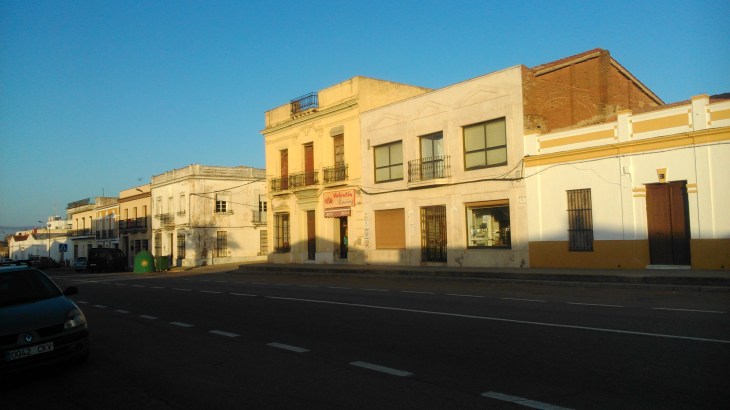
DSC_0138.jpgTorremejía has a touch of the wild west about it.  The main street is very broad, with a real jumble of architecture and the side streets shoot off at right angles, through long lines of anonymous white houses. However, everyone is very friendly and ready to help, if needed. It is a hard-working farming community.

When I arrived, it was Friday night and all were  out to have a good time – with the best  wine at 70 cents a glass who could blame them.  They yelled at each other up and down the bars, in ,what to me, was totally unintelligible Spanish and the caic was mighty.  However, don’t let them fool you, these people have great respect for peregrinos. They were really impressed to hear that I had come all the way from Ireland or, as they knew it, the land of constant drizzle.

DSC_0135.jpg

I stayed in the Albergue Turístico Municipal.  This is one of the government run hostals, some are good and some are very basic.  However, they all have bunk beds, hot showers, laundry, cooking facilities, and Wi-Fi and they are not expensive, perfect for the pilgrim on a budget.  This one is a beautiful and ancient building beside the Catholic church, at the end of town.  It costs €10 to stay for a night and €8 for a meal in the impressive dining room.

DSC_0136As I said, it is across the way from equally ancient Catholic church.  I noticed a lot of people going to evening mass.  Nowadays in Spain, this is far from the norm.  There is usually a gaggle of six to eight old ladies who spread themselves about, cat fashion, to give a clever impression of fullness.  Tonight was a different story.  It was a funeral mass and respects had to be paid.  At the end of mass, the bereaved family sat in front of the altar and everyone filed past.  They seemed surprised to see me, maybe not expecting people to travel so far.  However, I bowed ( as is the custom), they nodded ( as is the custom), and we all moved on with our lives.  A touching and charming way to offer condolencees and I  would expect nothing less from these sincere and genuine people.


Villafranca de los Barros

DSC_0127

I reached Villafranca about 3 and stopped at the first albergue on the old road coming into town – Albergue Turístico,  Las Caballeras,  €13 including a grandstand breakfast.  It opened in August this year and is very neat and clean with kitchen,  laundry,  lounge,  hot showers and hitec bunk beds.  The hospitalaria is called Rosaria and is very thoughtful and caring.   She lives in the house below with her son. Philippe (a policeman) and her grandson.

DSC_0129.jpg

I had the place to myself for a while but then, a footsore Brazilian called Julian arrived.  Later, the family called up for a visit.  Rosaria told us the sad story of how her young husband had died of AIDS contracted during a blood transfusion in La Paz Hospital,  Madrid, in the 1980’s.  However,  her son Philippe was fit and well and ran the Camino with a team-the local sport.   His son, also Philippe,  was celebrating his eigth birthday and looked up briefly from his presents to acknowledge our congratulations (¡felicidades!).  He is a member of the junior running team.

After they left, I introduced Julian to John Ross’s fine bottle of red – they were happy to meet. We then started to put the world to rights.  Brazil, it turns out.  is a very dangerous country where you can get shot outside your front door for your  small change.  The government has little intention and less ability to stop the destruction of the rain forest and turns a blind eye to global warming.  Her in Extremadura, we should be the rainy season, getting ready for planting in the spring.   Instead, it is hot and dry with the soil turning to dust.   It makes Ireland look like a green and pleasant land.

DSC_0120