Camino de Santiago(Via de Plata) Migas of Extremadura

DSC_0100.jpgI had no problems following the Camino out of Real de La Jara.  I simply walked to the end the village and picked up the old dirt road which had once been guarded by a mighty castle.  The road snaked through the beautiful Parque Natural for 12 kilometres and, where it met the new road, there was a café with good food.  The final 10 kilometres were not so great, close to the main road.  I got into Monesterio about 2.

The first building in Monesterio is the Turismo.  They were very keen to furnish me with maps but, sadly informed me that the Ham Museum ( El Museo de Jamon) was closed.  They like to keep in step with the Louvre and all the international museums, hence closed Monday. I had fancied getting more information on those dark and hairy princesses I have been keeping company with along the way, and maybe a nibble at one or two, to boot.  This news threw me back on my own devices – how to punch in an afernoon in Monesterio.

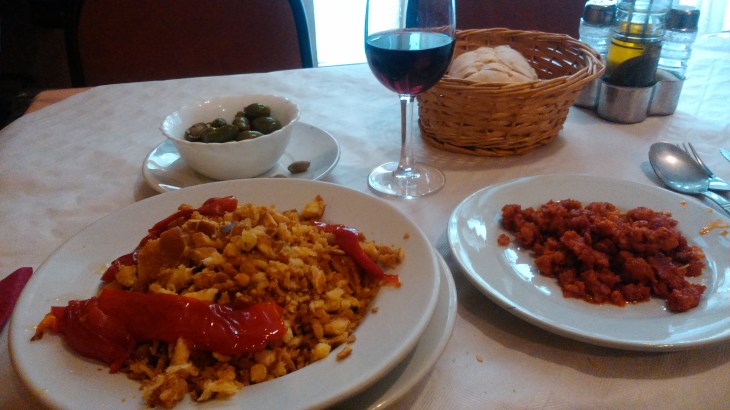
Dan The Turismo were able to recommend Hostal Pilar, €29 for a good single, a full meal and breakfast the next morning.  The comedor ( dining room) is just across the street.  They have an excellent menu del día and the waiter recommended migas, followed by riñones, washed down with a glass of local red ( see photos).  As they are all three specialities of the area, they would serve to celebrate my safe arrival in Extremadura. Fate then took a twist in my favour.  I discovered that the excellent local wine is only €1 per glass ( see photo of half empty bottle).  The afternoon slipped in rightly.  Fuentes de Cantos tomorrow 22 kilometres.
Have I Found Tartessos?

In Castilblanco, I stayed in the five star Castillo Blanco Hotel.  I know that this smacks of Camino lite, but it was the only option and a mere €25 for the peregrino.  Breakfast this morning consisted of a mountain of tostadas and all the coffee you can shake a stick at.  As I was getting in the carbs, I watched the television news. I got my first whiff of Tartessos.  It was being presented, in turn, by two goddesses Pilar and Maribel.  Pilar was blond with piercing blue eyes while, Maribel was drifting towards the strawberry blonde, with bottomless green eyes.  Pilar was speaking while Maribel stared in admiration.  Maribel’s body language was saying – Pilar you are so well informed about world events – but, in my opinion, her eyes were running naked through Pilar’s golden tresses screaming Celtic goddess.  I was tempted to wait and see if Pilar would return the compliment to Maribel but that Pilar, goddess she may be, she does love to hog the camera.

I left the goddesses to sort out the ways of the world. I had to make an early start, 30 kilometres,  mostly on road, but the final section through a very beautiful Parque Natural. My first port of call was to a small archaeological  site with, thought to  be, Tartessian aspirations.  This was strongly recommended to me as a ‘ must see’ by my landlady of two days ago in Guillena, Carmen.  Carmen really bought the Tartessian theory.  She said that the Andalusians felt more akin to the Celts than they did to some of  the other peoples in Spain,  especially looking north east.

The site was as disappointing as a pile of rocks can be, but I felt that, between the goddesses and Carmen, I was getting a sniff of Tartessos.  When I got back to the Camino, I met Herman.  Herman is a Belgian who is walking with his father Franc.  Franc is seventy-five years old but looks about fifty.  Nevertheless, he very wisely decided,  to take a taxi to the gates of the Parque Natural and walk the last 15 kilometres.  Herman and I were walking and talking when the taxi came back.  The driver explained that the Parque Natural was closed for hunting season and rather than having the father, Franc, hunted down like a dog in the Parque Natural, he had left him on the main road to walk safely into to town.  Ok, he didn’t use those words but I could read it in his eyes – dark brown, incidentally, not a whisper of Celtic goddess.  More from Tartessos later. In the meantime, I will continue to post photos on my Facebook page which should roughly correspond with the blog.

The First Day -Seville to Guillena

I arrived in Seville yesterday, 9th December, after a long day’s travelling. I stayed in Hostal Nuevo Suizo, just off the Calle Sierpes, right in the centre of town, and what it lacks in hot water it makes up for in atmosphere and friendly staff. If you like your hotels dripping in Gothic charm and don’t shower too often, it’s the place for you.

The first stage of the Via de Plata is from the cathedral in Seville to Guillena, a village 23 kilometres away. However, I had heard various reports alluding to ‘problems’, especially for lone walkers, between the outskirts of Seville and a village called Camas – the usual big city stuff. A very helpful lady in the tourist office advised me to simply take the bus to the next village after Camas, Santiponce, on a ‘just in case there are any of them bad boys about’ basis, and carry on from there. This turned out to be excellent advice. The bus leaves from the main bus station in the Plaza de Armas, platform 41 at the very end and it’s a local, so you pay on the bus – €1.50. After 35 minutes, it drops you off in the beautiful village of Santiponce, where you can visit both the Monasterio de San Isidoro and the ruins of Italica, where Hadrian (the wall man) was born.

The Camino continues through the village, along the road at first, but then, on a wonderful track across open fields, all the way to Guillena. It was a beautiful sunny day and even though it is December, sun cream, hat and sunglasses are still strongly recommended – we have come a long way from Tartessos. I am staying in a hostal called ‘Luz del Camino’. It is on the main street as you come in to town and is owned by a very interesting lady called Carmen. Her phone number is on the door and she comes running when you phone – it’s worth having a Spanish simm. Carmen is a camino enthusiast and appears to have walked them all, all over the world. She is very much into the mindfulness aspect of long distance walking-but more of that later. The house has everything and I have it all to myself for €12 – the washing is on as we speak.

Tomorrow – 20 kilometres to Castilblanco de los Arroyos.

Walking with my Spanish Uncles

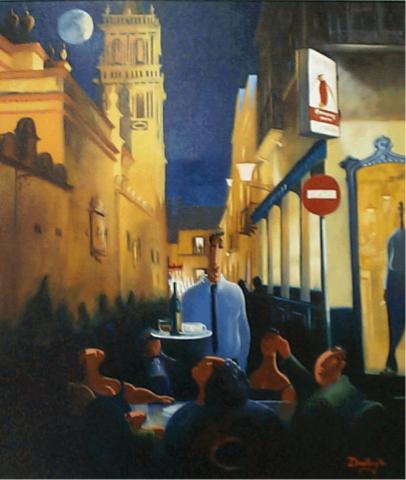
Sunday Night in the Triana (2)

“Sunday Night in the Triana, Seville” http://www.dandowling-artist.com

Have you ever felt a little bit Spanish? Does your pulse race to the rhythmic click of the castanets? Does your pacemaker skip a beat at the strum of the Flamenco guitar? It could be the emotional memory of long sunny days on the Costas or the echo of an ill-considered tapa, eaten in haste and digested in regret. However, if you consider yourself a Celt, a possibly fictional, but nonetheless, much-loved people, then could it be something in the genes?
John Koch makes much of this in his article (http://www.historyireland.com/pre-history-archaeology/tartessian-europes-newest-and-oldest-celtic-language/). He states that there is more than sufficient evidence to suggest that the Gaels or Celts originated in the Iberian Peninsula, in particular, in a place of immense natural wealth in silver and gold, called Tartessos. It is thought to have been situated in Europe’s south-west, beyond the Pillars of Hercules or possibly in a triangle between Malaga, Seville and Cadiz. Koch has found tantalising connections between the spoken language, Tartessian, and ancient Celtic and contemporary Irish. For example, in 550 BC the fabulously rich ruler of Tartessos was called Arganthonios (literally man of silver). In his name we can recognise the modern Irish word for silver, airgead, and the ancient Celtic word for silver, arganto.
The Leabhar Gabhála Na hÉireann (the Book of Invasions) https://en.wikipedia.org/wiki/Lebor_Gab%C3%A1la_%C3%89renn lists six conquests of Ireland culminating with that of the Milesians otherwise known as the Gaels or Celts. At that time, Ireland was, and had been for 150 years, occupied and successfully ruled by the Tuatha Dé Danann. The Tuatha Dé Danann were, and are, a supernaturally gifted and very cool people who favoured dark clouds as a means of transport. Nevertheless, after much to do, they conceded that the Gaels should take the above world in Ireland, and they, the Tuatha Dé Danann, that below (the other world), an agreement which has been honoured to this very day.
You will know from reading my previous blog, that I intend to walk the Via de Plata, an ancient route of some1000 kilometres, from Seville to Santiago de Compostela. This will be a personal voyage of discovery. I will be walking, blogging, and sketching. I intend to visit as many Tartessian and Celtic sites as possible. However, I do not expect to find any wild-eyed, Irish-speaking, tribes in the more remote parts of Extremadura but, maybe, some more intangible cultural connections. The word tio means uncle in Spanish but it is also used as a term of endearment between very old friends. If the Leabhar Gabhála Na hÉireann is anything to go by then, surly, the Irish and the Spanish share more than an uncle or two.
http://www.dandowling-artist.com

The Via de Plata

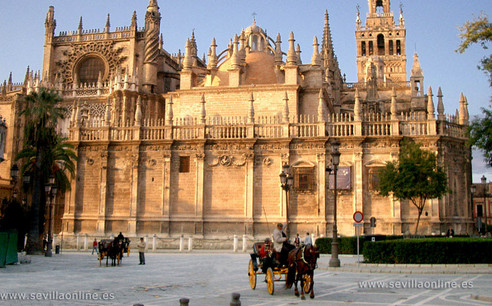
The Cathedral of Santa Maria de la Sede, Seville - the start of the Via de Plata.

The Cathedral of Santa Maria de la Sede, Seville – the start of the Via de Plata.

Later this year, 2015, and early next year, I intend to walk the Via de Plata, an ancient pilgrimage route in Spain. I am writing this blog to record the experience, both the factual details and my own personal thoughts and impressions. It will be a physical journey of 1000 kilometres. It will also be a journey through time, as I intend to explore the abundant evidence of Spanish Celtic connections. Finally, it will be a virtual journey along the information super highway, with the use of social media, Facebook and Twitter.
The Via de Plata was originally a roman road linking Asturias in the north of Spain with the port of Cadiz in the south. Its name, which means The Silver Route, dates from the Roman period, when it was used to transport silver from the mines of Asturias to Cadiz and hence to Rome. In the 9th century, it began to be used by pilgrims travelling to Santiago de Compostela. Nowadays, the route starts at the Cathedral of Santa Maria de la Sede in Seville (see image above).
I am an artist, a painter in watercolours and oils.http://www.dandowling-artist.com. My passions are art, walking, the philosophy of walking, Irish and Spanish language and culture, mindfulness, blogging and social media. I have always tried to live my art and, in this project, I intend to unite these many disparate elements of my life, in one piece of work.
The route will afford me the opportunity to visit the former Tartessos. This was an area between Seville, Malaga and Gibraltar where John Koch, in this article, (http://www.historyireland.com/pre-history-archaeology/tartessian-europes-newest-and-oldest-celtic-language/) adds a new twist to the assertion, long since dismissed as invention, that the Gaels originated in the Iberian Peninsula. There are substantial Celtic remains in Portugal and connections with Galicia are well-detailed in many sources, but especially the “Leabhar Gabhála na hÉireann” (the Book of Invasions). https://en.wikipedia.org/wiki/Lebor_Gab%C3%A1la_%C3%89renn
The whole experience – the walk, the social interaction, the exploration of Celtic connections and the blog through social media – will be a complete art project. It will also provide the inspiration for an exhibition of paintings and drawings, to be held in the Gerard Dillon Gallery, Cultúrlann, Belfast, in November 2016.