This is an easy 7 kilometres walk through Belfast, visiting some of the oldest streets as well as one of the newest locations in the city, a true journey in time. For a map and more information go to https://www.wikiloc.com/hiking-trails/botanic-joys-entry-the-mac-and-the-crown-43840385
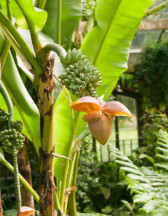
We started our time travelling at the Tropical Ravine in Botanic Gardens near Queen’s University. The Tropical Ravine is a celebration of our Victorian forefather’s ingenuity, their lust for travel, scientific research and collating their world. It has recently been refurbished back to better than pristine condition and is well worth a visit.
 We continued our walk down Botanic Avenue and into the centre of the city to Ann Street in order to explore the entries running from Ann Street to High Street. These alleyways dating back to the 17th century are where the town of Belfast was born and first laid out. They serviced a dense residential and commercial development. We choose to walk along Joy’s Entry, originally named after Francis Joy the founder of the News Letter the oldest English language newspaper. However, the entry is now a celebration of the life and times of his grandson Henry Joy McCracken, the acknowledged hero of the 1798 rebellion.
At the end of the entry, we turned left into High Street to shortly view the site of the gallows where Henry Joy was hanged. The gallows at that time was located further along Castle Place close to what is now the entrance to the Bank Buildings. However, Henry was given special attention, he was a freemason as were many of his fellow revolutionaries. The freemasons met in the Market House at the corner of High Street and Cornmarket. His gallows was erected in High Street, outside the windows of the Market House as an example to all.
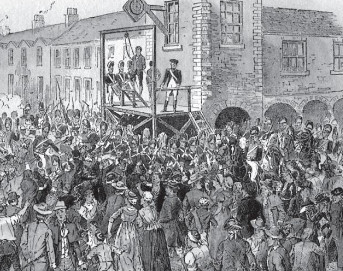
Execution of Henry Joy McCracken, 17th July 1798, he was 30 years of age
From this rather gruesome location, we crossed to Wine cellar Entry, home to White’s Tavern, a pub founded in 1630. At the end of Wine Cellar Entry, we turned right into Rosemary Street and continued across Bridge Street and into Waring Street to find, on the left, what was one of the most notorious, crime-ridden and dangerous locations in Belfast in the 19th century, Warehouse Lane. This now unprepossessing alleyway,
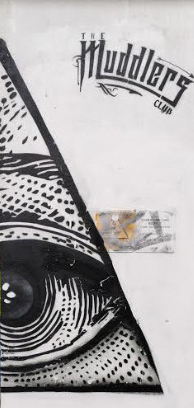
which was once sheltered the very poorest of society is now home to a Michelin star restaurant, the Muddlers Club. The name is a reference to the United Irish Men who held their secret meetings in the locality and the surrounding graffiti hints at masonic connections.
At the end of Warehouse Lane, we turned left into Exchange Place and back into Donegall Street. Here, at the entrance to Exchange Place, is a ‘plain’ looking building with a very important history.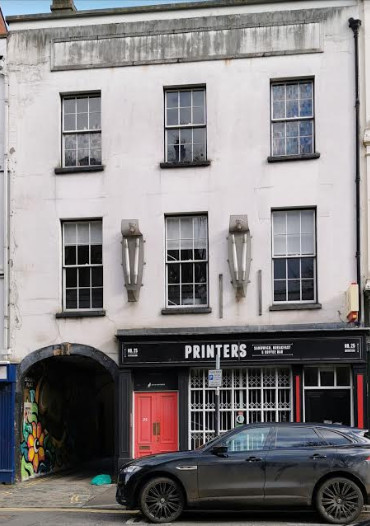
This was Belfast’s first maternity hospital established in 1794 due to the efforts of a small group of philanthropists. The aim of the hospital was to aid labouring ‘indigent females’ by providing accommodation, food and medical assistance during childbirth. https://www.qub.ac.uk/sites/irishhistorylive/IrishHistoryResources/Shortarticlesandencyclopaediaentries/Encyclopaedia/LengthyEntries/TheBelfastLying-inHospital1794-1903byLisaLavery/
From here we cut through Commercial Court past the fabulous Duke of York pub, turned left into Hill Street and then straight across into Exchange Street, formerly Robert Street, which runs between the back of St. Anne’s Cathedral and the new St. Anne’s Square. Belfast became a city by royal charter in 1888. Robert Street, then, was a notorious crime and poverty-ridden area and only confirmed its grim reputation by becoming the site of the first murder in the new city. The bloody deed took place just opposite the main entrance to St. Anne’s Square and for all the gory details go to “The Darker Side of Belfast’s History” by Joe Baker.
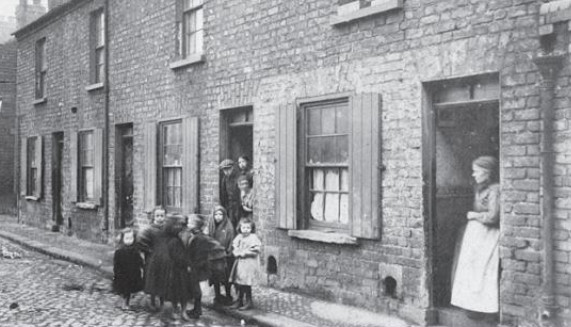
The former Robert Street, now Exchange Street, at the entrance to what is now St. Anne’s Square but then the site of bloody murder.
For some relief from murder most foul, we turned our steps to one of Belfast’s newest buildings, the MAC to be inspired not only by the interior of the building but also by the current exhibition Mark Garry’s “Songs and the Soil”.
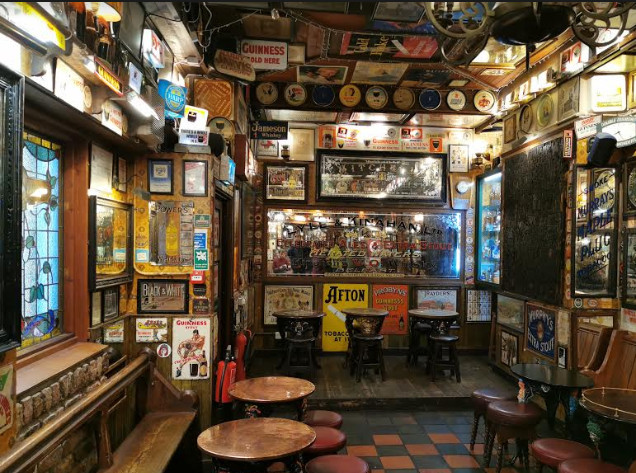
And so ended our time-travelling through what was only a soupcon of Belfast’s rich and often dark history. But time-travelling is thirsty work and to round off the day, we returned to the fabulous Duke of York for light libations.
 dandowlingblog
Hi Dan,
A great journey down memory lane visiting places and events spanning almost 400 years. Most interesting and quite inspiring. I wish I could have joined you. Enjoy life; live it to the full.
Cheers ☘️🍷☘️
LikeLike
Hi Joe,
Yes, a great walk, I love travelling through history when we can’t get down to the mountains.
LikeLike