My exhibition called “Via de Plata” opens tomorrow night, Thursday 1 December, at 7pm, in the Cultúrlann, Falls Road, Belfast. The work was inspired by a 1000 kilometres walk, I completed this year.
The original idea was to make Celtic/Spanish cultural connections. I started with the Tuatha Dé Danann. Back in the mists of time, the Milesians, a people from northern Spain, invaded and occupied Ireland, bringing with them their Celtic culture and language. They displaced the incumbent Tuatha Dé Danann who agreed to move to the underworld 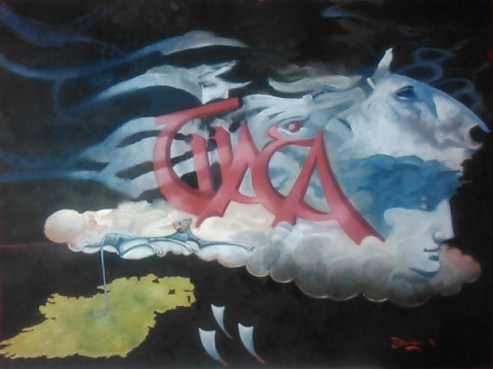 where they remain to this very day. I then investigated Tartessos, a fabulously rich pre-Roman Celtic city thought to be located between Seville and Cadiz, in southern Spain. It was once thought to be a myth but with mounting evidence, it is not only emerging into reality but it is almost certain that a form of Gaeilge (Tartessian) was spoken there. http://www.historyireland.com/pre-history-archaeology/tartessian-europes-newest-and-oldest-celtic-language/
During my investigations of Tartessos, I was made aware of three isolated villages in the remote mountains on the frontier between Spain and Portugal, San Martin de Trevejo, Eljas and Valverde del Fresno where the local linguistic variation is Fala, different from both Spanish and Portuguese but thought to be related to ancient Tartessian/Gaeilge.
https://en.wikipedia.org/wiki/Fala_language. 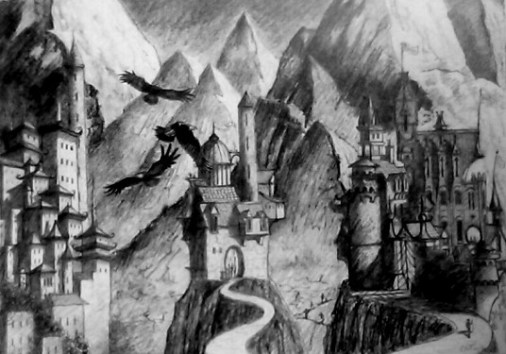
When we reached Salamanca, we visited the Taberna Celta and met the owner Caesar whose hospitality and generosity is legendary. Apart from the glorious food and wine, he entertained us with stories of the history of the Caminos. He told us that the ancient Celts starting walking the Caminos in pre-Roman Iberia. They followed ley lines, lines of energy, not to Santiago de Compostela, but to Finisterre, Spanish for the end of the world.
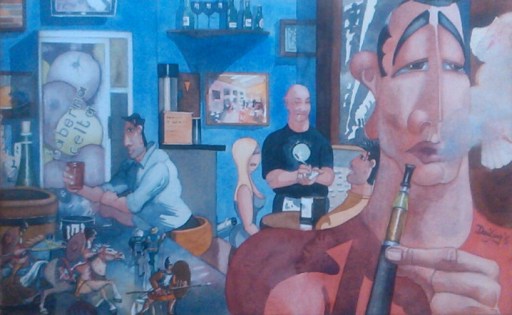 They made these journeys, not out of necessity, but to examine and explore their concept of reality. They walked to the very edge of what they thought was a flat earth and peered over the edge into the abyss. They watched their sun-god disappear into oblivion, in the west, every evening and then reappear, in the east, next morning. That must have been an exceptional reality trip.
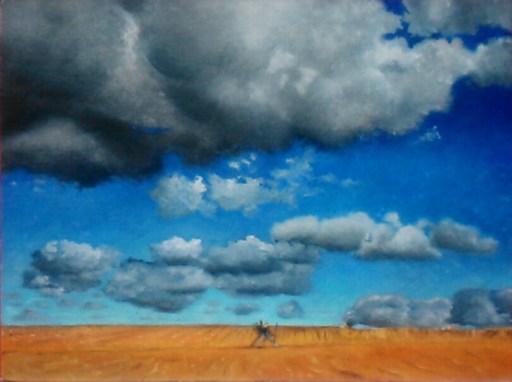
We left Salamanca and set off across the Meseta. The Spanish Meseta covers 210,000 square kilometres and has an average elevation of 660 metres. In other words, it is vast, it is incomprehensible, it is another world. After a few days walking under those enormous skies, you very slowly realise that reality has become a mere concept and, no longer, are there any hard and fast rules. You can walk to the very limit of your life experience and, like the ancient Celts, peer over the edge into the abyss and see what you find there.
 dandowlingblog
[…] The Exhibition […]
LikeLike
Hi Dan,
I hope you had or you are enjoying a great holiday in milder weather. Are you back in circulation?
I had your painting framed and it is about to take ‘Centre Stage’ on the wall of my living room. The frame was fitted by County Galleries (Railway Street, Altrincham) for a cost of £80. I will send you a photograph of the painting in position when I next e mail you.
I can send you a receipt for the framing if you require one. Please do not send me any payment toward the framing exercise; I look forward to you treating me to a few meals when we manage to evolve a plan for a walking holiday in wherever.
Ta
Joe
On Wed, Nov 30, 2016 at 9:07 PM, dandowlingblog wrote:
> dandowlingblog posted: “My exhibition called “Via de Plata” opens tomorrow > night, Thursday 1 December, at 7pm, in the Cultúrlann, Falls Road, > Belfast. The work was inspired by a 1000 kilometres walk, along an old > Roman road, I completed this year. The original idea was to make” >
LikeLike