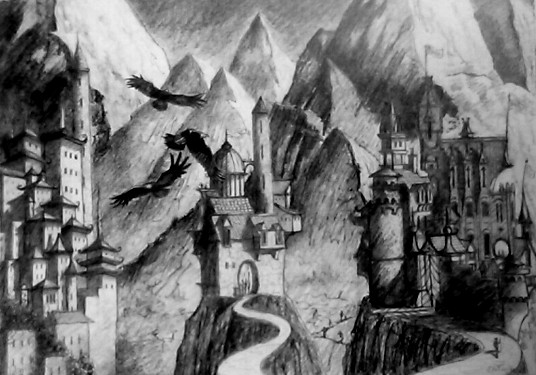
This is one of four drawings which will be shown at my forthcoming exhibition in December 2016. The exhibition will be based on my experiences on walking the 1000 kilometres long Via de Plata from Seville in southern Spain to Santiago de Compostela in the north. My previous blogs are available at the bottom of the home page on my website http://www.dandowling-artist.com
One of my initial ideas on undertaking this journey was to investigate ancient Celtic/Spanish connections. I was especially interested in the fabulously rich, pre-Roman, Celtic city of Tartessos. Tartessos was once thought to be a myth but the myth is slowly merging into reality. For more information go to John Koch’s article http://www.historyireland.com/pre-history-archaeology/tartessian-europes-newest-and-oldest-celtic-language/ in which he suggests that Tartessian is ‘more than a little bit Celtic’ and adds a new twist to the assertion, long since dismissed as invention, that the Gaels (Milesians) originated in the Iberian Peninsula.
In Extremadura, Tartessos is accepted as a historical fact and, frequently mentioned, are three villages located in a very remote valley, in the northwestern part of the province, where, it is said, the remnants of the Tartessian language is still spoken. The language is called Fala. The three villages are nor only remote from both Spain and Portugal but so remote from each other that three distinct dialects have emerged although they are mutually intelligible with each other.
San Martín de Trevejo is the smallest of the three, with a population of 926 people and their dialect of Fala is called “Manhegu”. Eljas has a population of 1046 who speak “Lagarteiru” and in Valverde del Fresno with a population of 2576 they speak “Valverdeiru”. I managed to visit San Martín de Trevejo and listened to the Fala language. Was I listening to a version of ancient Tartessian and according to John Koch, Irish? It was interesting, to say the least. However, even more, intriguing is the fact that the Fala language whilst unrelated to modern-day Spanish or Portuguese has always been mutually intelligible with Galician. Just think of the Milesian ( modern-day Galicia) invasion of Ireland, as recorded in “Leabhar Gabhála na hÉireann”. It is difficult not to draw conclusions.
https://en.wikipedia.org/wiki/Lebor_Gab%C3%A1la_%C3%89renn
The drawing shows the three villages, very much on a “once upon a time” theme, high in the mountains where the eagles fly. The exhibition will open on Thursday 1 December 2016, in the Cultúrlann, Falls Road, Belfast.
 dandowlingblog
[…] Where Eagles Fly […]
LikeLike
Fascinating drawing Dan looking forward to seeing it in ur exhibition . The Meseta painting great, still my favourite CAMINO MOMENT is the day we walked on the Meseta and the night sky when we started
LikeLiked by 1 person
Cheers Natalie, I remember it well. Dan
LikeLike
A great painting and a very thought provoking description; full of intrigue. Make sure the chardonnay is appropriately chilled! May the brush be with you. Joe
LikeLike
Cheers Joe, Talk soon!
LikeLike