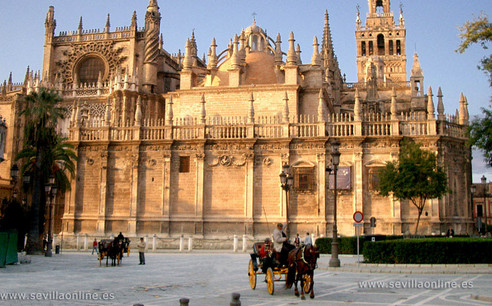
The Cathedral of Santa Maria de la Sede, Seville – the start of the Via de Plata.
Later this year, 2015, and early next year, I intend to walk the Via de Plata, an ancient pilgrimage route in Spain. I am writing this blog to record the experience, both the factual details and my own personal thoughts and impressions. It will be a physical journey of 1000 kilometres. It will also be a journey through time, as I intend to explore the abundant evidence of Spanish Celtic connections. Finally, it will be a virtual journey along the information super highway, with the use of social media, Facebook and Twitter.
The Via de Plata was originally a roman road linking Asturias in the north of Spain with the port of Cadiz in the south. Its name, which means The Silver Route, dates from the Roman period, when it was used to transport silver from the mines of Asturias to Cadiz and hence to Rome. In the 9th century, it began to be used by pilgrims travelling to Santiago de Compostela. Nowadays, the route starts at the Cathedral of Santa Maria de la Sede in Seville (see image above).
I am an artist, a painter in watercolours and oils.http://www.dandowling-artist.com. My passions are art, walking, the philosophy of walking, Irish and Spanish language and culture, mindfulness, blogging and social media. I have always tried to live my art and, in this project, I intend to unite these many disparate elements of my life, in one piece of work.
The route will afford me the opportunity to visit the former Tartessos. This was an area between Seville, Malaga and Gibraltar where John Koch, in this article, (http://www.historyireland.com/pre-history-archaeology/tartessian-europes-newest-and-oldest-celtic-language/) adds a new twist to the assertion, long since dismissed as invention, that the Gaels originated in the Iberian Peninsula. There are substantial Celtic remains in Portugal and connections with Galicia are well-detailed in many sources, but especially the “Leabhar Gabhála na hÉireann” (the Book of Invasions). https://en.wikipedia.org/wiki/Lebor_Gab%C3%A1la_%C3%89renn
The whole experience – the walk, the social interaction, the exploration of Celtic connections and the blog through social media – will be a complete art project. It will also provide the inspiration for an exhibition of paintings and drawings, to be held in the Gerard Dillon Gallery, Cultúrlann, Belfast, in November 2016.
 dandowlingblog
I hope you have an event full journey . We will make do with a very pleasant Autumn here. Sean Dillon
LikeLike