Unknown's avatar

Posts by dandowlingblog

Dan Dowling is an artist who works both in oils and watercolour. He tries to live his art and draws his inspiration from his own life experience, his native north Belfast, walking and the philosophy of walking, Irish and Spanish language and culture, blogging and social media.

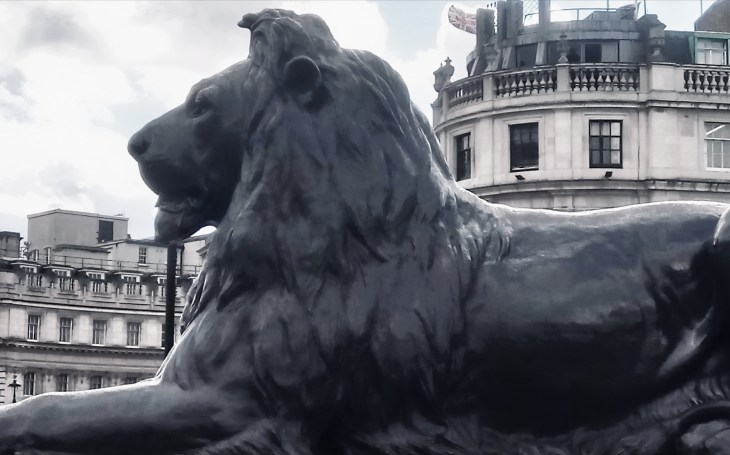
A Week in London – the lions in Trafalgar Square, lions or pussycats?

Here’s the skinny on the lions in Trafalgar Square and what artists have to do to make do. After much hullabaloo the commission for the four bronze beasts was given to Sir Edwin Landseer, Queen Victoria’s favourite 🎨 painter.

_20170911_163140

Landseer had an unrivalled reputation as an animal painter but had never sculpted anything in his life. He spent hours in London zoo studying the lions there but under time pressure and struggling with poor health,  he had to resort to using an ordinary domestic moggie 🙀 as a model.

The end result, the four bronze lions,  are both majestic and magnificent. But it’s nice to know that there is a bit of pussycat in there as well.


A Week in London-A Mummified Philosopher

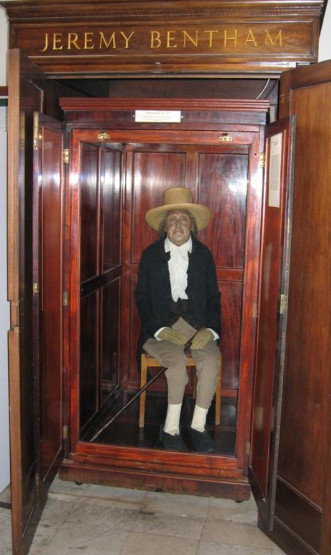
Bentham 2Today we visited the auto-icon of Jeremy Bentham in University College, London, a very curious experience indeed.  At the end of the South Cloisters of the main building stands a wooden cabinet which contains Bentham’s  preserved skeleton dressed in his own clothes, sitting in his favourite chair and surmounted by a wax head.  Bentham requested that his body be preserved in this way in his will made shortly before his death on 6 June 1832. He called it an Auto-Icon (‘man in his own image’), whereby a man’s actual corpse replaced the traditional memorial statue.
Now, this was no ghoulish indulgence on my part, Bentham has been a hero of mine for some time.  He was a visionary and a great humanitarian, with ideas far in advance of his time. He believed in universal sufferage, the legalisation of homosexuality and utilitarianism, a doctrine which aims to promote the greatest happiness for the greatest number of people.
He left his organs to medical research and so the skeleton is there but the body beneath the clothes is simply stuffed with straw.  Nevertheless, there is a presence and people are plainly taken-aback no matter what they are expecting or how well informed they are. They tend to descend into deferential whispers in front of the cabinet. In fact, their reactions on first seeing the Auto-Icon are recorded by a hidden camera.
Originally, Bentham’s head was to form part of the exhibit.  It was to be preserved by a Maori practice of desiccation and for ten years before his death, Bentham, allegedly, carried the glass eyes that were to adorn it in his pocket.   Unfortunately, the head deteriorated rapidly into such a gruesome condition that it had to be replaced with a wax likeness.
Rumours persist that the Auto-Icon attends meetings of the College Council.  Its presence is recorded in the minutes with the words ‘Jeremy Bentham – present but not voting’.
Bentham

A Week in London-What Remains of Newgate Prison?

Viaduct2

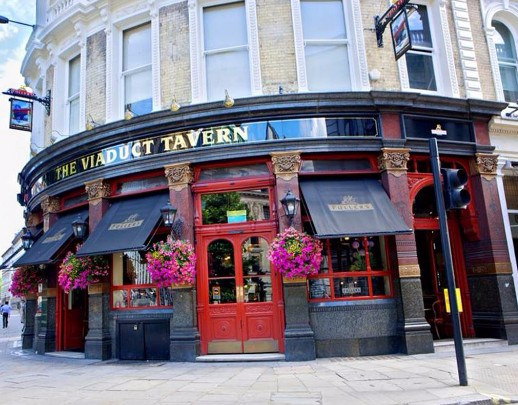
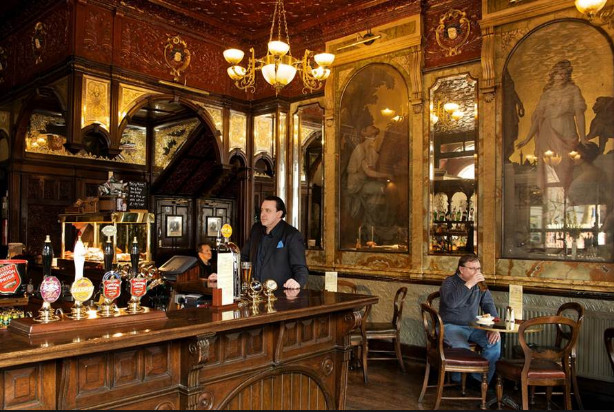
The Viaduct Tavern, 126 Newgate Street,  is a beautiful old Victorian tavern.  It has a wrought copper ceiling and a triptych of oil paintings representing Commerce, Agriculture, Science and the Fine Arts.  There was an opium den upstairs in the 19th century, but alas now closed.  However, the food and drink, the victuals served in the bar are excellent.

Viaduct

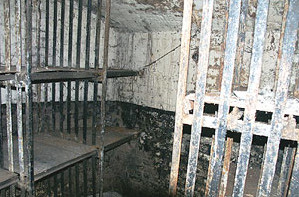
But what lies beneath?  Little remains of the infamous Newgate Prison.  It was London’s main prison for five centuries and built in a style known as ‘architecture terrible’ in an effort to discourage law-breaking.  The prison closed in 1902 but below the Viaduct Tavern cells have survived and they are genuinely horrible: cold, damp and

Viaduct 1

dark and in sharp contrast to the comfortable lounge upstairs.  Up to twenty criminals – usually debtors – were crammed into each one in what must have been total misery. Prisoners had to pay for the privilege of being locked up – or starve to death.

This is not only a regular haunt of ghost hunters and tales of bumps in the night and apparitions abound.  But it is also a genuine opportunity to visit the underbelly of a great city’s less salubrious past.


A Week in London

I am spending a week in London with my friend Gary.  We are staying just behind Tate Modern, a great location. However, rather than visit the big tourist attractions yet again, on this trip we are determined to find the odd, the obscure, the kitsch and the lesser-visited places of interest.

I have always been a Holmes and Watson devotee but standing outside the Abbey National Building Society at 221b Baker Street, their fictional address, has always been nothing short of a deflating experience.  However, I have recently discovered that in 1951, as part of the Festival of

Holmes2

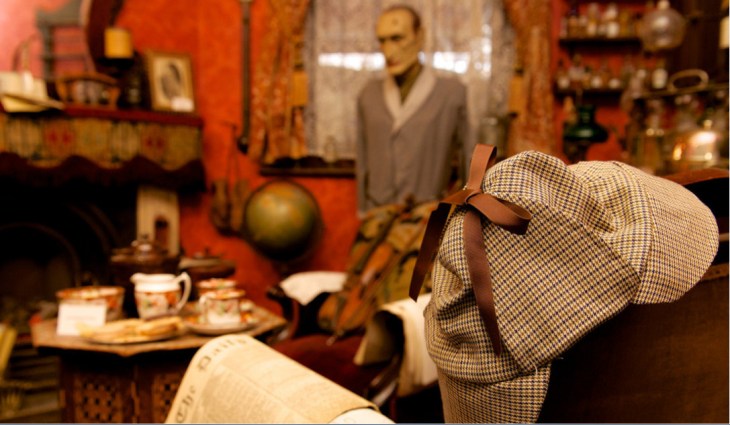
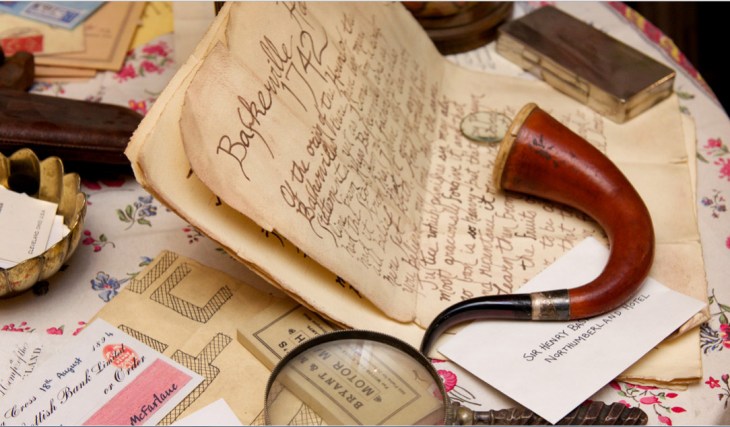
Britain, the building society staged an exhibition at its offices, recreating the sitting room at 221b according to the theatre design of Michael Weight.  This can be found today, intact, in the former Northumberland Arms pub, now known as the Sherlock Holmes.  It is delightfully kitsch but the attention to detail makes it worth it.

Holmes 1

There is a reference to many of the stories, for example, The Red-Headed League and The Adventure of the Dancing Men.   The is a wax dummy of the famous detective with a bullet hole in his forehead, a reference to The Adventure of the Empty House.  To top it all the food and craft beers are excellent.  I think Holmes and Watson would have been very much at home here.  

The Gentle Art of Drawing

I have always thought of drawing as a form of meditation or mindfulness.  It is a process which not only involves hand, mind, and heart but also it is essential to stop thinking and to and live in the moment, in fact, to go beyond thinking.

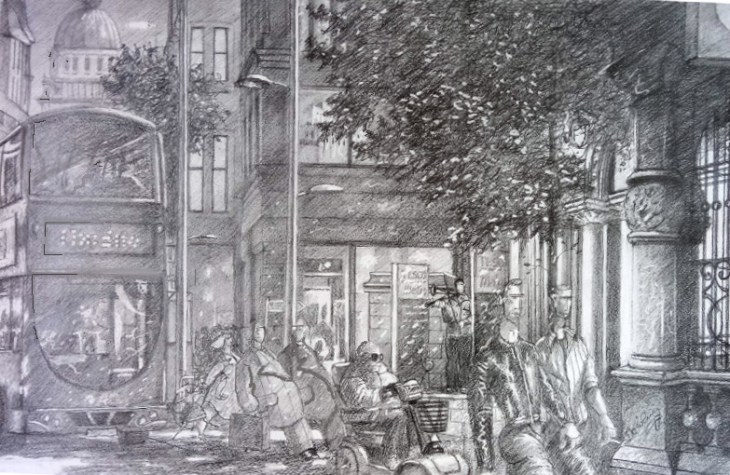
In the City 1

That sounds very arty-farty, I know, but everyone knows how to get into their own particular, special zone.  The philosopher Friedrich Nietzsche said, “You never exist quite so much as when you are not thinking.” and that guy knew a thing or two.  So why not grab a pencil or better still a big piece of charcoal, slip the brain into neutral and get down and dirty with a bit of sketching.  But, don’t expect perfection because it ain’t out there.

In the City 2

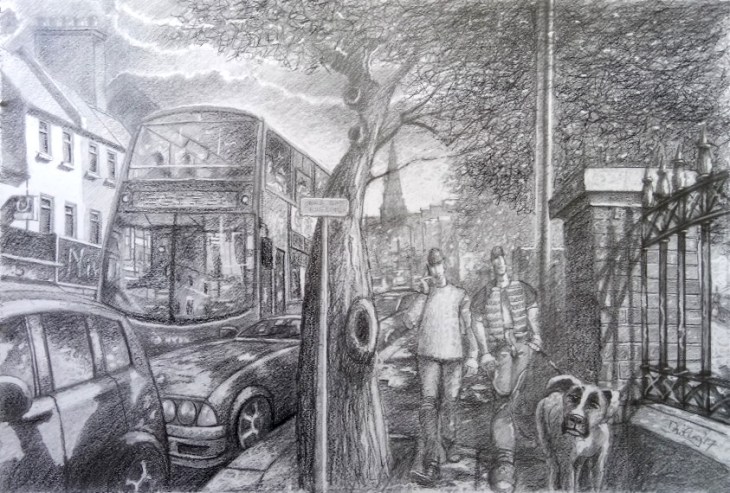
Above are of two of my recent drawings, pencil on paper.  Whilst the act of drawing involves a non-thinking mode, there is a certain thought process behind the images.

They represent the journey of life and how we should live our lives, in other words, my favourite hobby horse.   Is the journey of life just a case of getting through, going along with the crowd and joining the club or should we commit to our lives?  Should we take hold of our own life, manifest our talents and become the person that we really are?  The first drawing shows a moment in time and a moment in life on the Antrim Road, Belfast near the Waterworks Park, a very familiar location to me.  The second shows an endless stream of people walking through the centre of Belfast, passing Tesco Metro and the Reform Club.  There is a musician who, daily, scratches out a tune near this location.  He plays an unusual instrument called a Stroh violin or phonofiddle.  Here, in this drawing, he is providing the background music to this march of humanity through their lives.


Dan and Joe’s Tour of the Wild, Wild West-Great Blasket ( An Blascaod Mór)

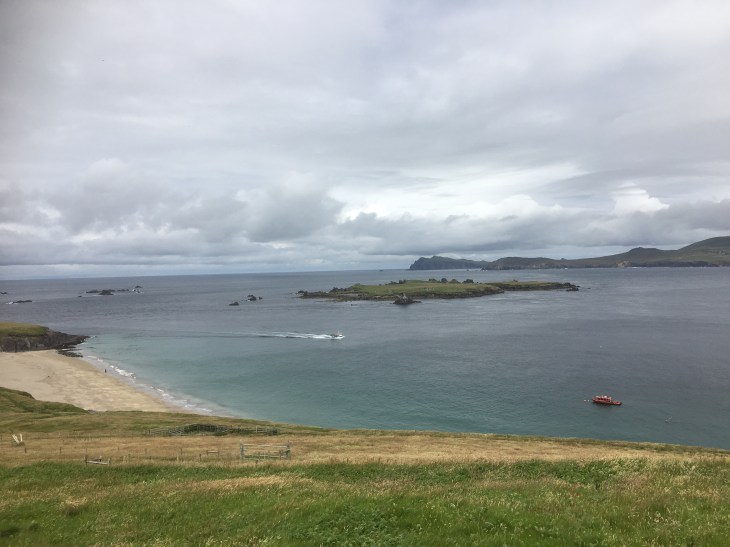
Joe and I were going to find it difficult to top our experience on Skellig Michael but Great Blasket came very close.  Great Blasket has been occupied from pre-history and it overlooks the location where a number of the Spanish Armada ships were wrecked. A small farming and fishing community exceeded a population of 150 in the early 20th century but then dwindled to a small number when the island was vacated in 1953. The old village above the Trá Bán (White Strand) is situated on the north-eastern side of the island, facing the mainland and Slea Head.
C81

We organized the boat trip and a two-day stay on the island through Billy and Alice on https://www.greatblasketisland.net and I couldn’t fault the experience.  We left from Dingle Harbour in Billy’s boat the Peig Sayers.  Billy is not only a very friendly guy and an expert boatman but also a fund of local knowledge.  On the trip to the island, he introduced us to Fungi the dolphin and he was able to bring the boat close to the cliffs to explain many local and geological features.
C83

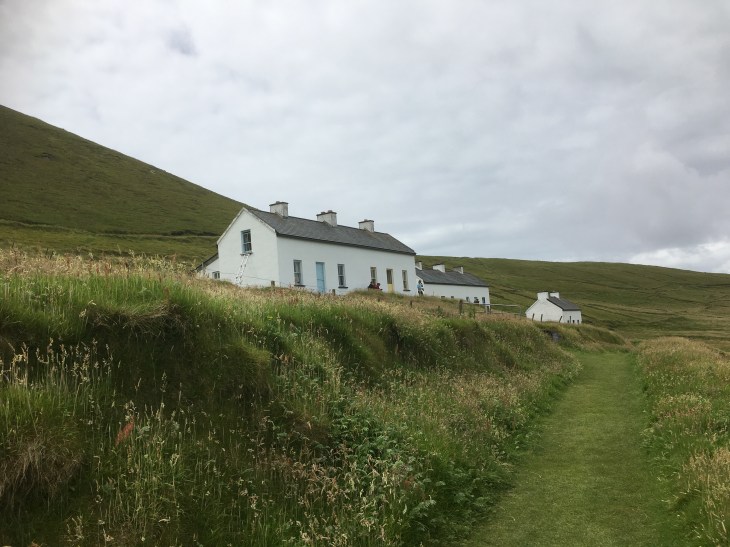
When we reached the island we were delighted to find that we were to stay in Peig Sayers house.  Now, Great Blasket isn’t all about Peig Sayers, in fact, the island has produced many renowned writers; Tomás Ó Criomhthain, Peig Sayers, Muiris Ó Súilleabháin, Eibhlis Ní Shúilleabháin, Seán Ó Criomhthain, Máire Ní Ghuithín.  This embarrassment of creativity and literary wealth has to be a testament to the inspirational environment to be found on this tiny piece of earth.  However, since you are staying in her house it’s worth doing a bit of research on Peig as a way of getting in touch with local history and culture.
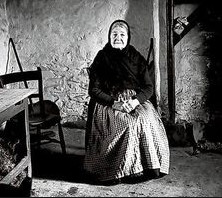
Peig Sayers

Peig Sayers (1873-1958)

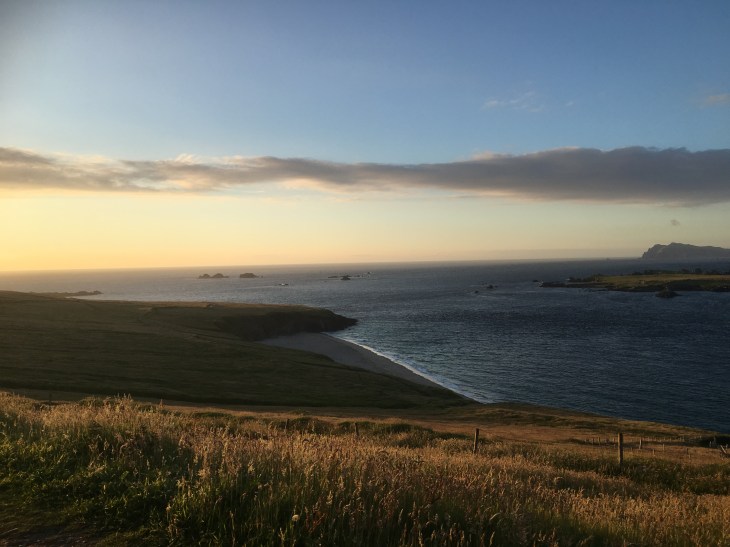
Peig, although not a native, lived on the island from 1892 to 1942.  She was a legendary story teller and recorded her biography as well as hundreds of ancient legends, ghost stories, and folk tales.  As many a student of the Irish language will attest, she comes across as a gloomy old gal but maybe she had just cause, life was tough back in the day.  You also get the impression that she lived in black and white as we are used to her staring out at us from old photographs. However, as Joe and I sat outside her house we realized that she lived in glorious Technicolor under massive skies. The view must have given her much joy and many uplifting moments, although not altogether obvious in her work.  It’s like looking at a map of another world with the smaller Blaskets in the foreground, the mainland of Ireland off to the right and the majestic and mysterious Skelligs on the horizon.
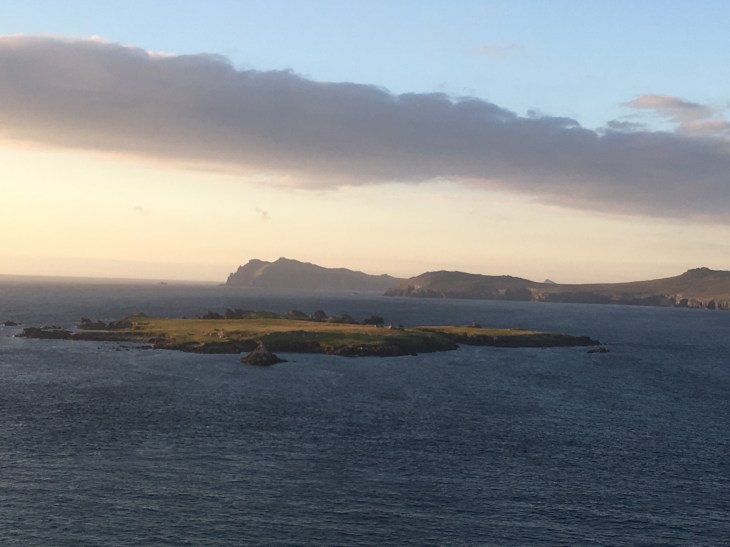
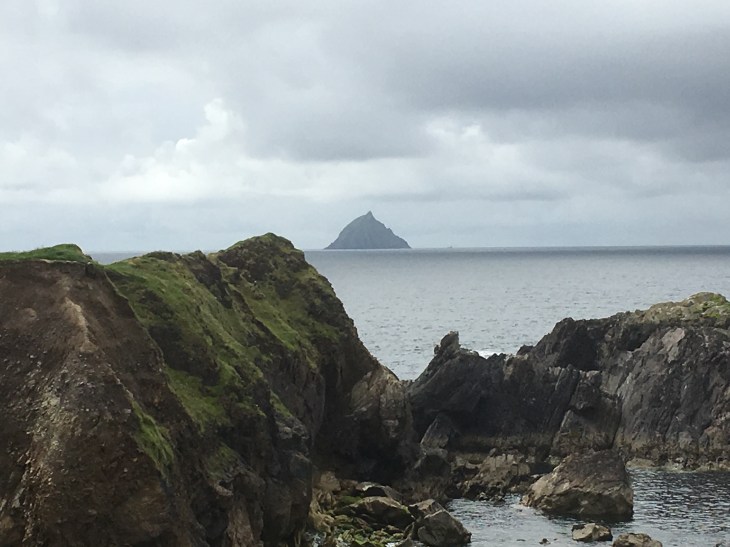
Blasket 1

Blasket 2

The accommodation is hostel style with no electricity or hot water.  If you are expecting fresh fluffy towels and a mint or your pillow every night, then this is not for you. However, if you enjoy that thrill of excitement at the chance to tap into another world and, maybe, find out something about yourself then this is a must.
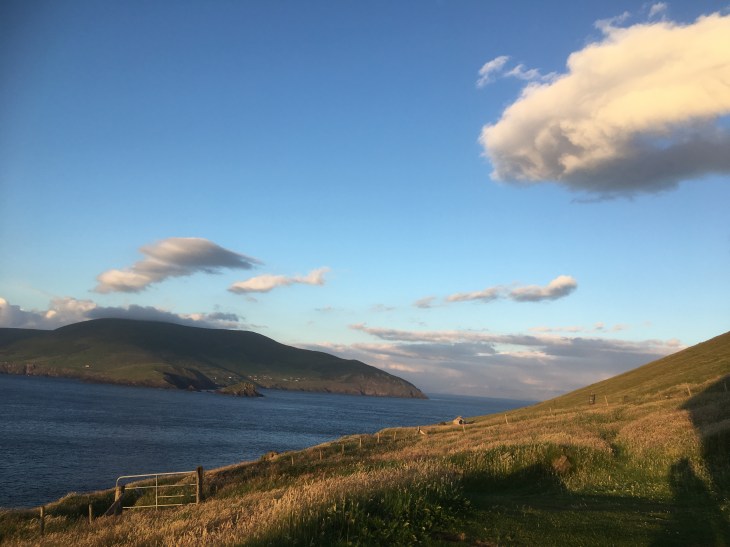
Blasket 4

Walking on the island is a great pleasure.  I am sure there are many dark days during the winter but while Joe and I were there the light was not only shimmering but constantly changing making every walk a fresh adventure and Great Blasket a very special place.
Blasket 5


Dan and Joe’s Tour of the Wild, Wild West-Skellig Michael

Skellig Micheal 1

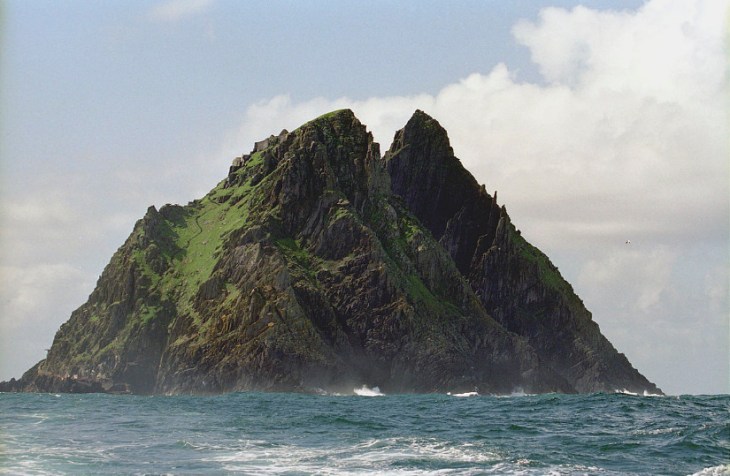
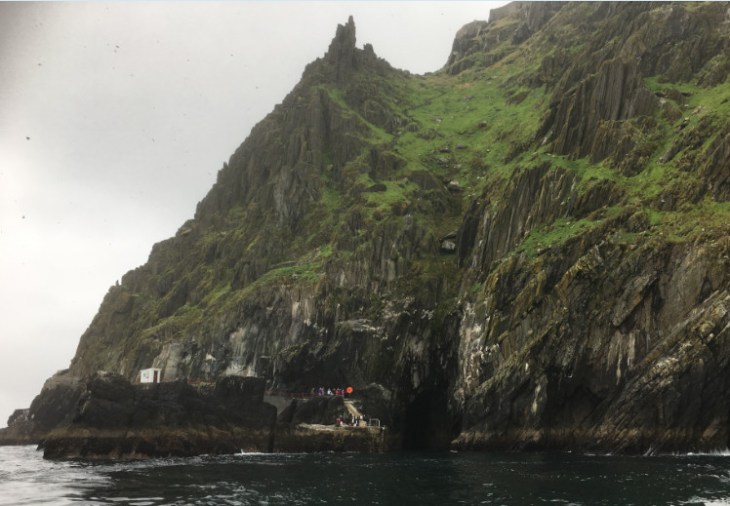
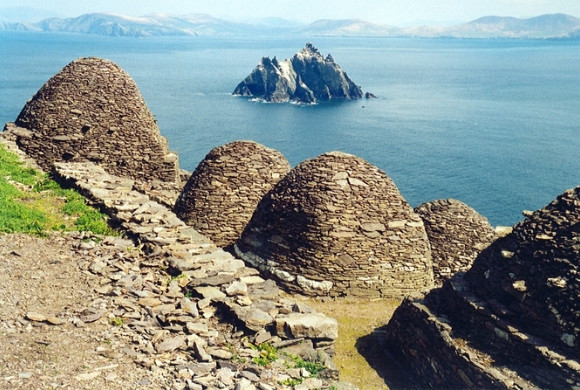
Skellig Michael is not only the most westerly point in Europe but it is also a very special place, a place apart.  In the 6th century, monks came here to what was the very edge of their  world and then started building upwards into the heavens, in search of reality. They built a monastery on a narrow ledge 160 meters above sea level.

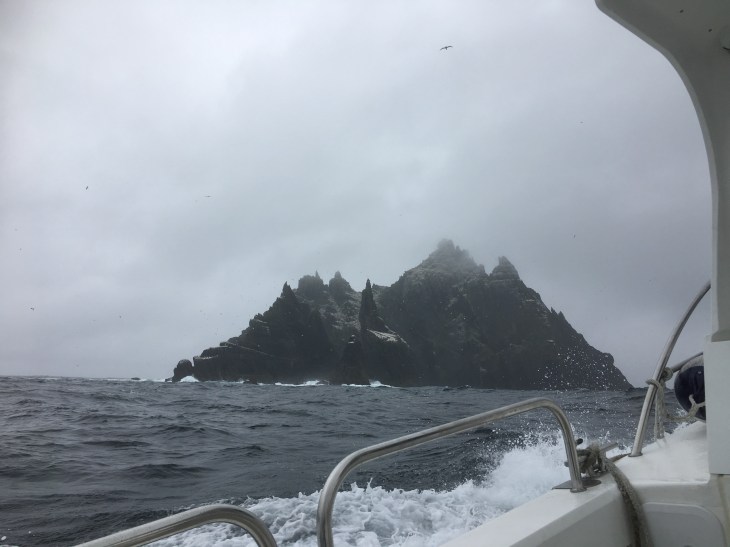
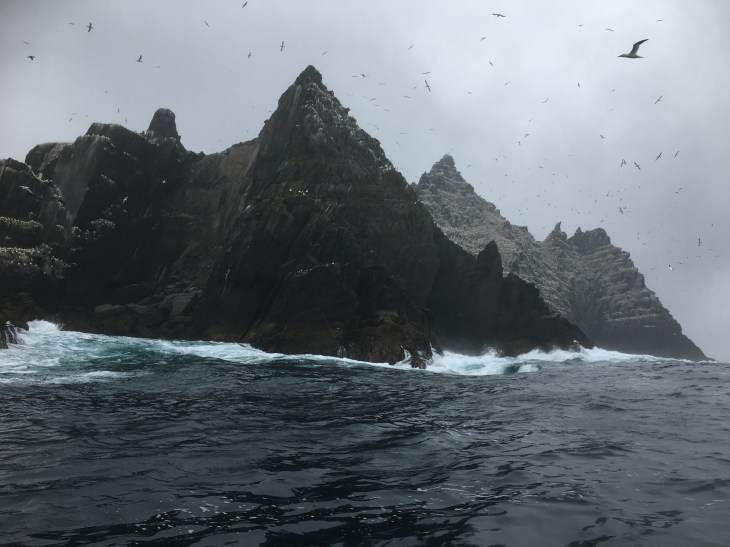
There are two islands Skellig Michael and Little Skellig.  As you approach,  they have an otherworldly appearance, the appearance of maybe an alien spaceship or at least something that has dropped out of the sky rather than part of the natural landscape.

Skellig Micheal1.5

The Skelligs had been on my bucket list for some time and I realized that boats left from Valentia Island.  However, I had always understood that space was limited, the trip was very weather dependent and had to be booked well in advance.  So we went to the tourist center on Valentia that morning with the intention of taking a boat trip around the islands without landing.  We had been told that this was just as interesting but believe me it is not, not even close.  However, it appears that hotels block book spaces on the boats for their guests but they regularly fail to turn up.  Destiny played a hand that morning and we were offered two places on the first boat.

Skellig Micheal3

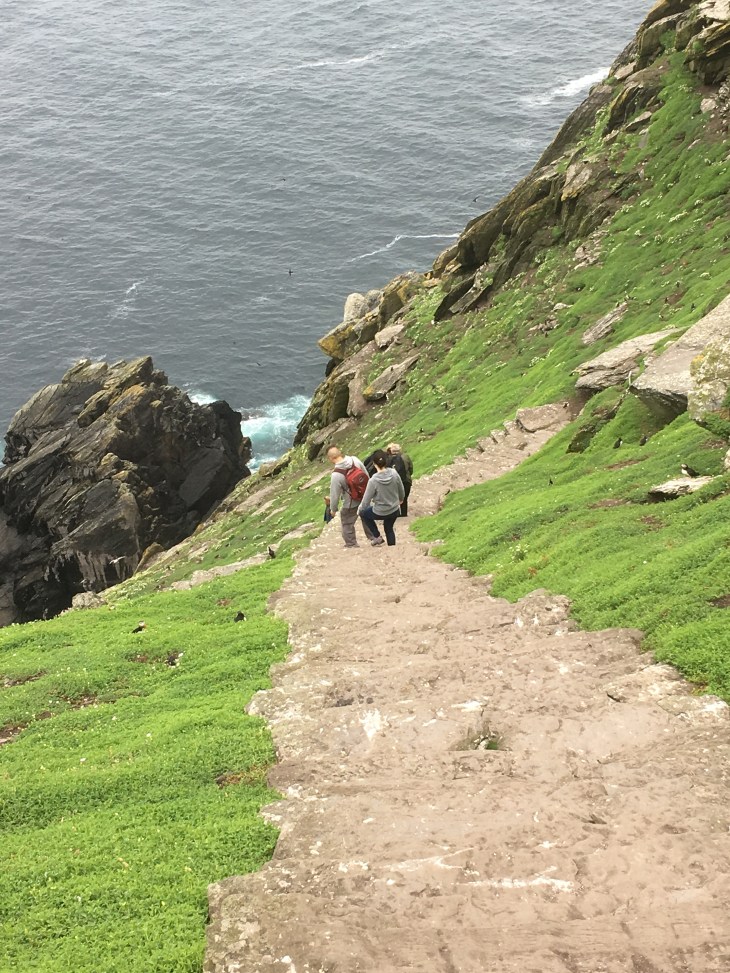
A journey in a small boat, in the wild Atlantic, is exciting enough but when you reach the tiny jetty you realize that every piece of level ground and every foothold, including the one thousand and more stone steps up to the monastery with its bee hive cells, were carved out by the monks.

Skellig Micheal5

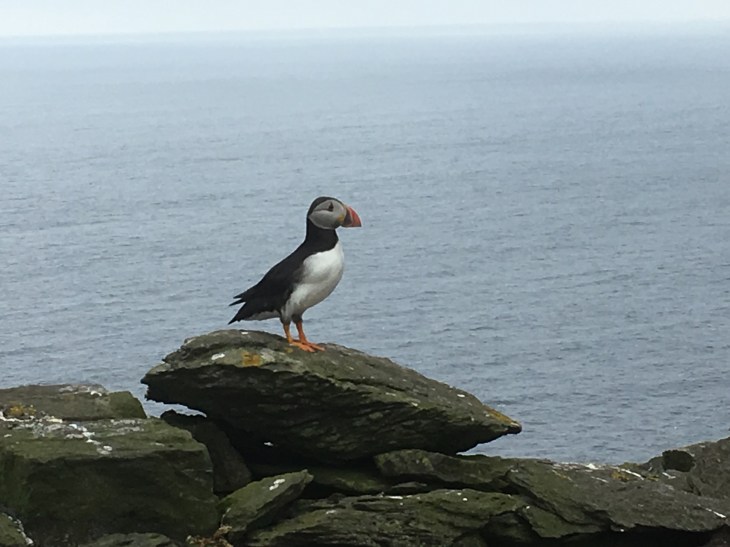
As you ascend the steps, you become aware of the abundant bird life, especially the puffins who are so plentiful and tame, it is difficult not to trip over them.

Skellig Micheal4

Having reached the monastery, you lose sight of the boats, the harbour and the 21st century.  It’s hard to believe that nothing remains of those men who lived here in splendid isolation for 6 centuries.  Maybe, today they are still there in spirit and enjoy mingling with the tourists.

Skellig Micheal8

A visit to the Skelligs is a life experience.  Whether or not those monks from ancient times walk amongst the visitors today,  they have left behind something incredible, an example of commitment to an ideal which will last forever.

Skellig Micheal6


Joe and Dan’s Tour of the Wild, Wild West

C4

Joe and I have been best friends since we met at school in the dark and troubled days of seventies Belfast. We had made several trips around Ireland as teenagers and, many, many moons later decided to recreate the experience with a little island hopping in the wild, wild west.

C3

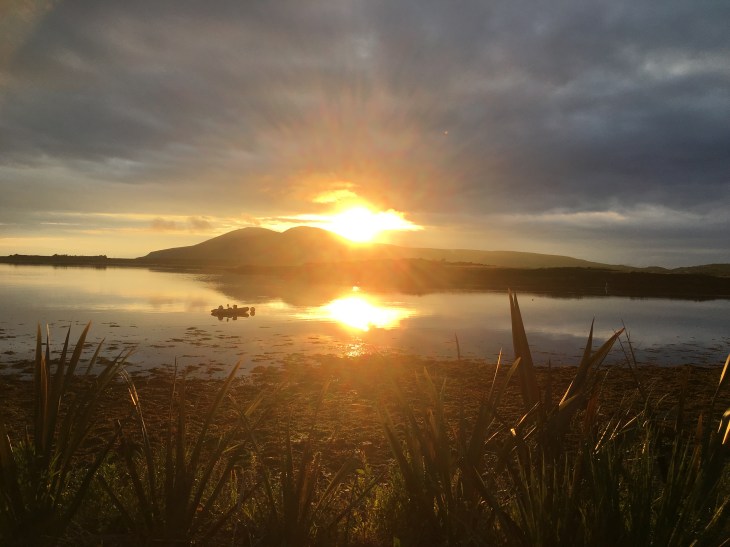
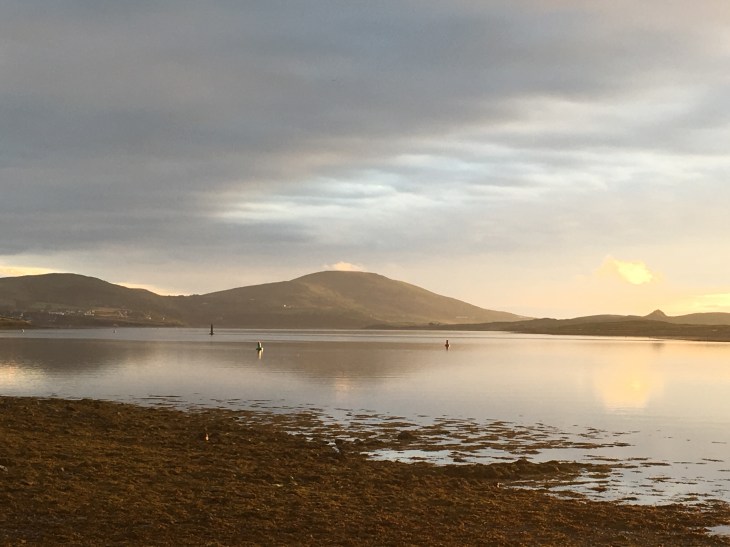
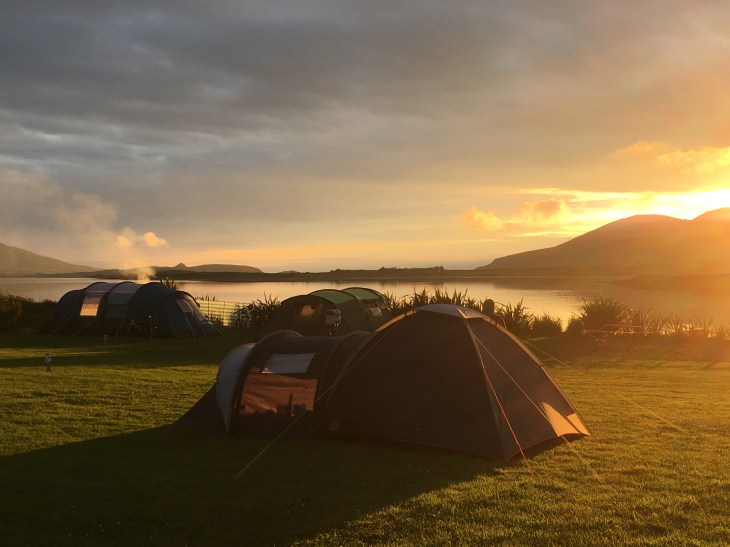
We started our trip with two nights camping at Mannix Point, Cahirciveen, in the Ring of Kerry, on the Wild Atlantic Way. http://www.campinginkerry.com/  Mannix Point claims to be the most beautiful camping/caravan/motor home site in Ireland and I think that the claim is well justified.  It has a fabulous location, the facilities are excellent and the sunsets are incredible.  It lies within an easy walking distance of the bustling little town of Cahirsiveen.  Although a few empty shops in the main street tell us of tough times, Cahirsiveen is a charming lively place where unusually enough, the Catholic church is named after the local hero Daniel O Connell.

C5

Mannix Point is within a short drive of Valentia Island. htttp://www.theringofkerry.com/valentia-island

C18

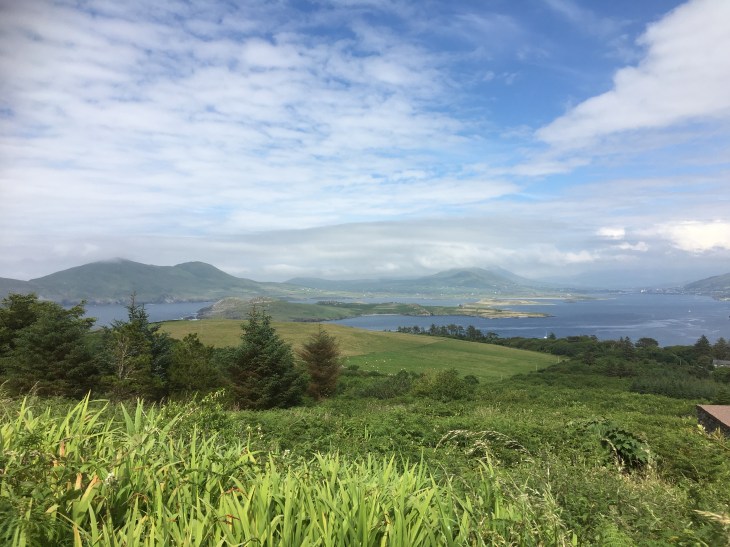
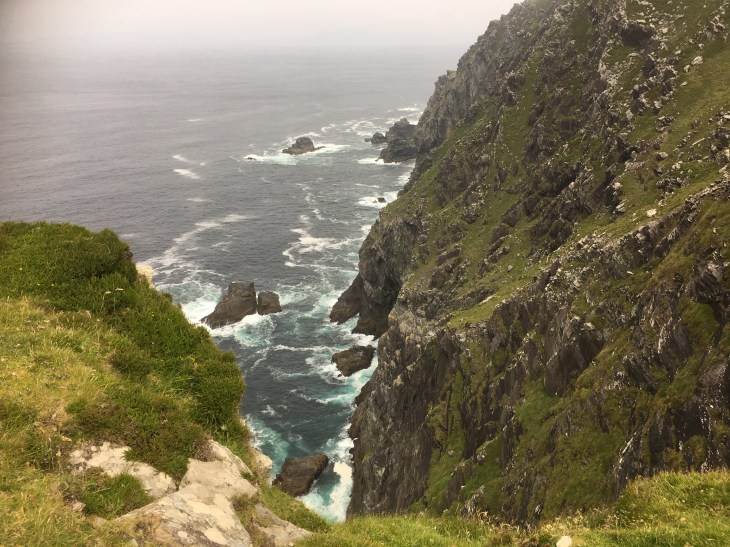
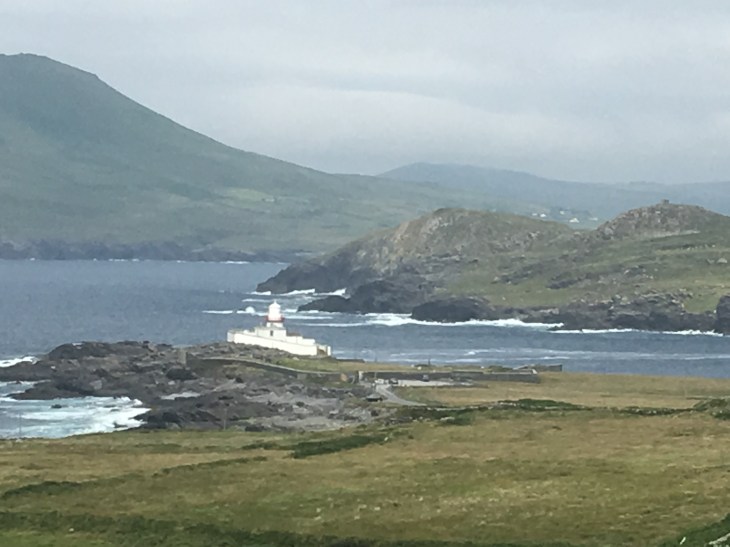
Valentia Island, (strictly speaking it’s no longer an island as it was connected to the mainland by a bridge in 1971). It, while small in size (approx 12km x 5km) contains a number of interesting sites which when combined with the location makes it a place well worth visiting.  The island itself consists of two small villages Knightstown & Chapel town. Roads on the island tend to be narrow even by Kerry standards and some of the sights to the north of the island (lighthouse etc) are best accessed on foot. The cliff walk and the walk to the old lighthouse give views which are second to none.

C14

However, most tantalising for me was the fact that the boat to Skellig Michael leaves from the tourist centre on Valentia.   Skellig Michael has always been very high on my bucket list and I spent our second night under canvas not only snoring, so I am informed but also dreaming of Skellig Michael, the end of the world.

C19