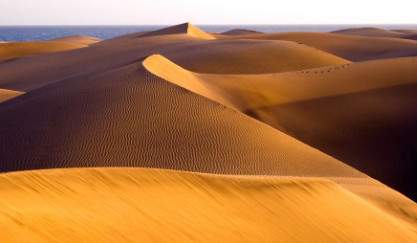
The Dunes at Maspalomas
My friend Gary and I recently spent ten days in Gran Canaria. We stayed in Playa de Ingles, on the south coast of the island. Playa de Ingles is at the centre of six-kilometres of mass tourism stretching from Puerto de Morgán in the west to San Agustín and further in the east. Many people spend a very pleasant week or three here, leading a hedonistic lifestyle and following the tourist’s eternal triangle; bar, beach and bed.
This is a very beautiful area and the local people are extremely friendly. The climate is one of the best in the world, with temperatures between 18 and 25 degrees centigrade all year around. The beaches are stunning and no more so than around the dunes at Maspalomas. It does have an illusory quality and in fact, it is a purpose built tourist mecca dating back to the 1960s, built on what was virtually a barren though a gorgeous desert. However, an hours drive away into the mountains brings you to another world.
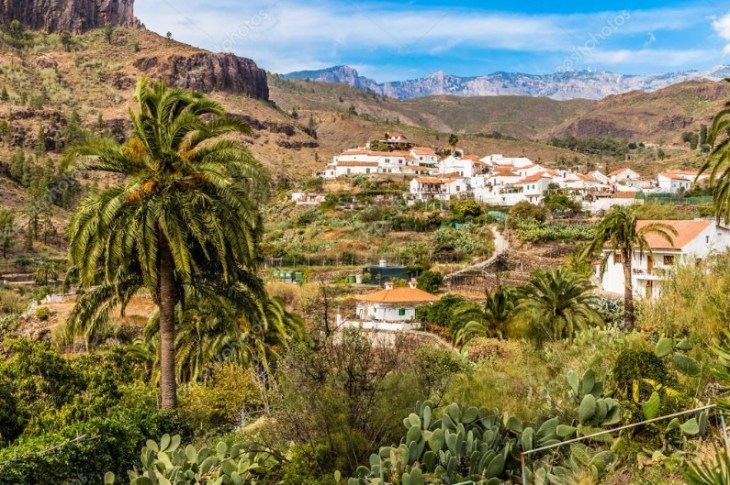
We took the road for the Barranco de Fataga, the biggest gorge in Gran Canaria which offers great walking opportunities. Further on, the village of Fataga gives a real taste of Canarian life and food.
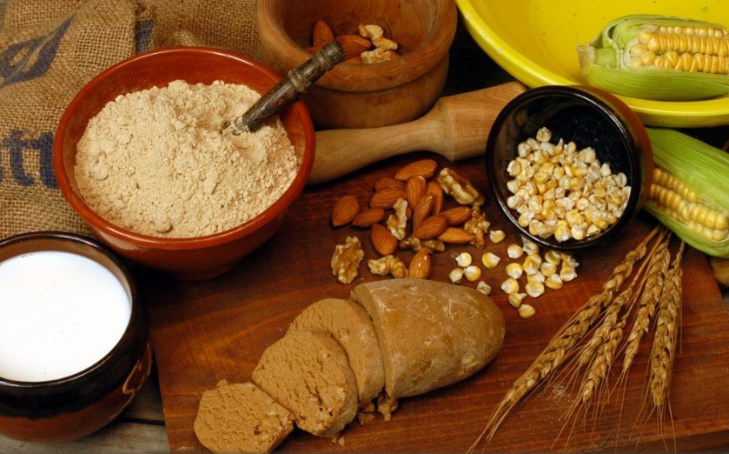
Climbing even higher it is hard to believe that the small town of San Bartolomé de Tirajana is the municipal capital of the south coast. However, if you consider that the resorts of Maspalomas and Playa de Ingles were literally invented in the 1960s, it makes more sense. People here make their living from farming, the almond being particularly important. Another taste of real Canarian life.
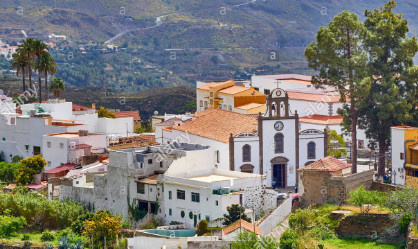
San Bartolomé stands on the site of a former Guanche settlement called Tunte, a name used by local people to this day.
Guanches were the aboriginal inhabitants of the Canary Islands. It has been recently confirmed that they are closely related to the Berbers of North Africa. It is believed that they migrated to the archipelago around 1000 BC or perhaps earlier.
After the Spanish conquest of the Canaries, they were ethnically cleansed by Spanish soldiers after a long and bloody struggle. Many famous battle sites are recorded and monuments erected to courageous Guanche warriors. Elements of their culture survive to this day, intermixed within Canarian customs and traditions such as Silbo (the whistled language of La Gomera Island).
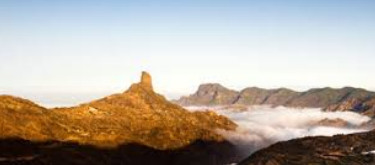
At 4,606 feet we reached Roque Bentayga a sacred site and refuge of the Guanches. Excavations have uncovered several groups of cave dwellings, together with granaries, cattle pens and burial sites. Some of the caves are painted with fertility symbols and this is where examples of ancient inscriptions can be found, not deciphered to this day.
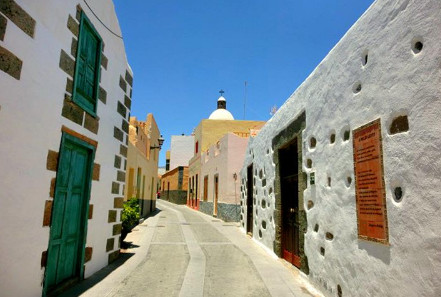
We left the land of the Guanches and drove southeast to reach the mountain village of Aguimes. Aguimes was founded in 1486, shortly after the conquest of the island. It has wonderful small streets and several bars serving good Catalan food.
This has been a very brief tour of Gran Canaria, not even touching on the capital Las Palmas. The fleshpots of Maspalomas may be a great place to relax and party till dawn but there is so much more to this island, it is a land steeped in history and culture.
 dandowlingblog