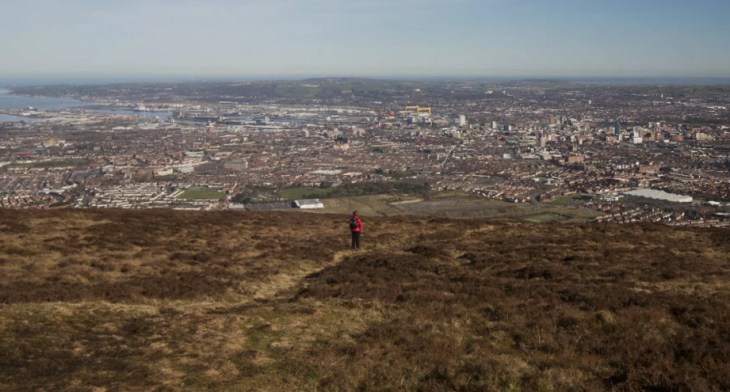
This is a walk not only dripping with history: a highway man’s buried treasure, the last wolf in Ireland and a noble hunting ground but also great views of the city of Belfast and a wealth of nature including red grouse, skylarks and peregrine falcons. For a map and detailed statistics go to https://www.wikiloc.com/hiking-trails/divis-to-cavehill-belfast-23845640
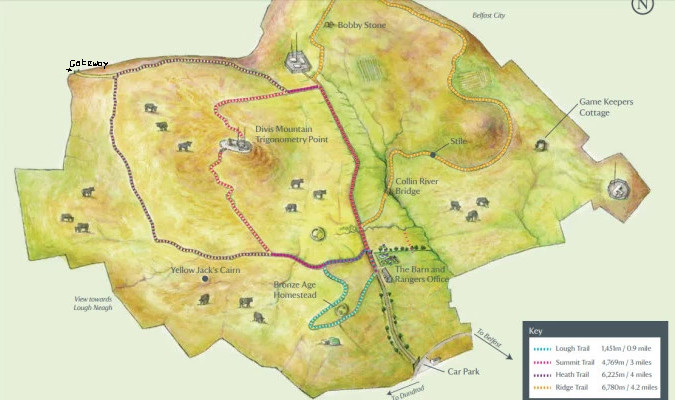
We started the walk at the National Trust car park on Divis Road, off the Upper Springfield Road. This is a linear walk so it is worth arranging return transport.
We followed the path to the café and then took the Lough Trail. When we reached the Heath Trail we turned left uphill to reach the Summit Trail which brought us up and over Divis Mountain. On the other side of Divis, we turned left on the Heath Trail again and continued straight ahead to reach a gateway as marked on the map above.
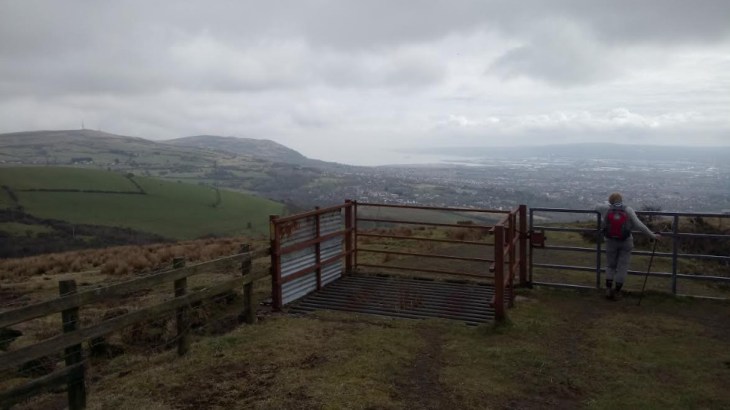
Gateway at the end of the Heath Trail. Go left here across rough open ground to reach a stile beside a stream.
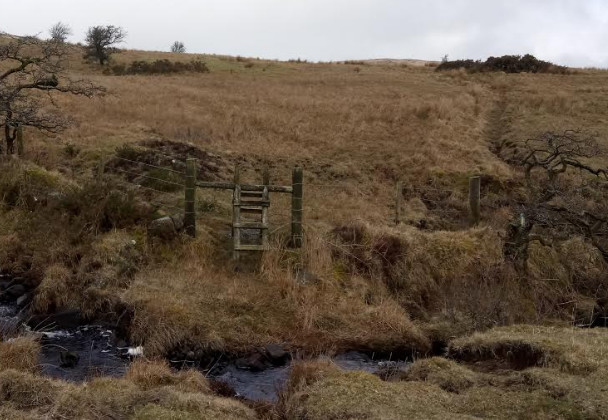
From here we kept left and crossed rough open scrubland, dropping down to cross a stile beside a stream and then climbing up to the ridge to find an old road going left, right.
To the left, there is a red brick building and the remains of a village which was once occupied by a family of highwaymen and in particular, the highwayman of the hills Neece O’Haughian. His farming family had been dispossessed of their land during the Plantation of Ulster. O’Haughian took revenge by becoming a highwayman. He robbed the rich and offered to help the poor farmers. He hid out in the Belfast Hills until his capture in 1720. The outlaw of the hills was hanged at Gallows Green, Carrickfergus. His treasure is said to be still buried in the Belfast Hills, five jumps to the east of a spot where you can see five castles, five loughs and five counties. It’s worth having a look and the old village is a great spot for lunch.
From the village, we continued along the old road towards Cavehill, passing Wolf Hill and Wolf Hill Quarry and finally, coming to a gate giving access to the Upper Ligoniel Road. The name Wolf Hill originated as the last wolf in Ireland is said to have been shot there by a farmer in 1692.
At this point on the Upper Ligoniel Road, due to an access dispute, it is necessary to make a short detour. We went right, down the hill, took the first on the left and then left again on to the Ballyutoag Road and veered slightly right on to the Flush Road. While making this detour, you will notice one of the low points of an otherwise beautiful walk. The amount of litter thrown out by passing traffic is appalling.
Once past the houses on the Flush Road, we crossed a stile on the right and by keeping to the left of the fence we crossed a series of small crude stiles which brought us up to the summit of Squires Hill. This was once part of one of the biggest estates in County Antrim and the hunting ground of the Donegal’s and the rich linen barons.
We dropped down the other side passing an old quarry to reach the Upper Hightown Road. We turned left to reach the Cavehill Country Park, within a few hundred metres.
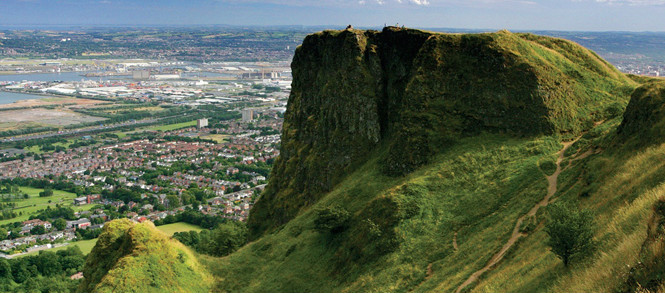
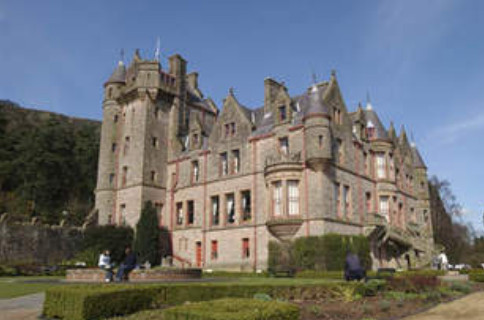
The signage in the park is excellent and took us easily to McArt’s Fort https://en.wikipedia.org/wiki/Cavehill and finally to Belfast Castle.
 dandowlingblog