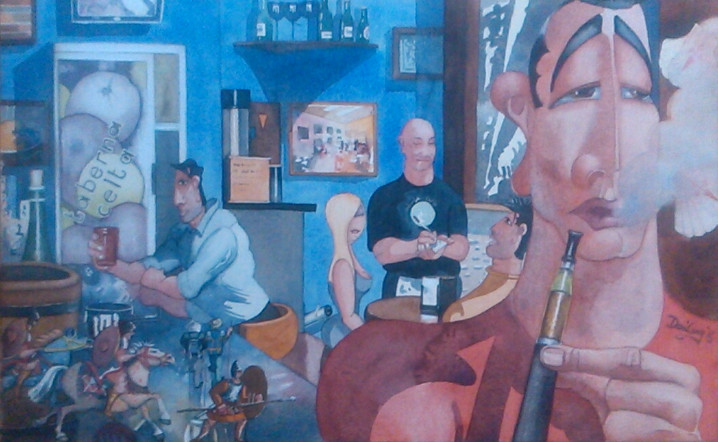
This is a painting from my forthcoming exhibition. The images were inspired by a 1000 kilometre walk I made in Spain this year, 2016, from Seville, in the south, to Santiago de Compostela, in the north. It is a watercolour on paper, 37×54 centimetres and called ‘ In the Taberna Celta, Salamanca’.
Salamanca is an ancient, monumental, university city with a touch of magic woven into its fabric. Victor and I booked into the very friendly municipal hostel and on our first afternoon exploring the city we drifted inexorably towards the renowned Taberna Celta. The Taberna Celta is a small bar and restaurant near the cathedral and also a mecca, a meeting point and a must visit for all pilgrims walking the Via de Plata. The owner Caesar is notorious for his almost life threatening generosity and hospitality.
We spent a glorious afternoon not only being plied with wonderful food and wine but also being regaled, by Caesar and his friends, with stories of Salamanca and the Camino. According to Caesar, during the last ice age, the ice advanced as far as the Pyrenees. Hence, most of the people of northern Europe moved south in advance of the glaciers and eventually came to live on the Iberian peninsula bringing with them their ancient magic and wisdom.
The Celts or Celtiberians, who occupied most of the peninsula in the final centuries BC, started walking Caminos along lines of energy, ley lines, not to Santiago de Compostela but to Cape Finisterre (the end of the known world), to worship the sun-god. Where the ley lines intersected were important hot spots of energy and the Celtiberians marked them with temples and later cities, such as Salamanca. The Romans realised the importance of ley lines and built their roads along them. The energy in the earth ionises the air above it, giving energy to marching soldiers. The Via de Plata follows exactly the original Roman road. During the second world war, the Germans visited the cave system behind Salamanca to investigate rumoured ancient sources of energy. Unfortunately, for whatever reason, they failed to publish their findings and, in spite of our enthusiasm, we were quietly dissuaded from attempting a visit the caves.
We spent the next couple of days examining every nook and cranny in the city. Having walked across the vast Meseta for weeks, reality had become a concept rather than a fact. We felt that we were just touching the surface of something very intriguing, yet another reality, something very special but it wasn’t ready to let us in.
The painting shows the interior of Taberna Celta, with the customers as I remember them and Caesar as the waiter. However, in the foreground, two pilgrims stride along the counter, accompanied by a group of Celtiberians. The exhibition will open on Thursday 1 December 2016, in the Cultúrlann McAdam Ó Fiaich, 216 Falls Road, Belfast.
 dandowlingblog