My exhibition called “Via de Plata” opens tomorrow night, Thursday 1 December, at 7pm, in the Cultúrlann, Falls Road, Belfast. The work was inspired by a 1000 kilometres walk, I compl…
Source: The Exhibition
My exhibition called “Via de Plata” opens tomorrow night, Thursday 1 December, at 7pm, in the Cultúrlann, Falls Road, Belfast. The work was inspired by a 1000 kilometres walk, I compl…
Source: The Exhibition
My exhibition called “Via de Plata” opens tomorrow night, Thursday 1 December, at 7pm, in the Cultúrlann, Falls Road, Belfast. The work was inspired by a 1000 kilometres walk, I completed this year.
The original idea was to make Celtic/Spanish cultural connections. I started with the Tuatha Dé Danann. Back in the mists of time, the Milesians, a people from northern Spain, invaded and occupied Ireland, bringing with them their Celtic culture and language. They displaced the incumbent Tuatha Dé Danann who agreed to move to the underworld 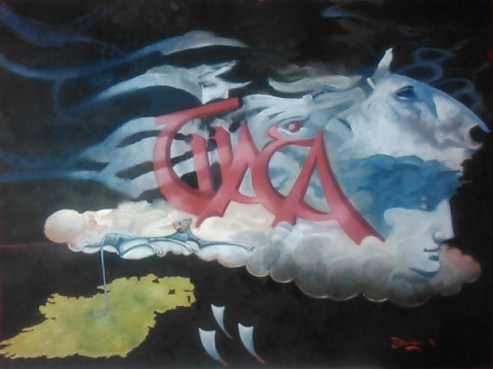 where they remain to this very day. I then investigated Tartessos, a fabulously rich pre-Roman Celtic city thought to be located between Seville and Cadiz, in southern Spain. It was once thought to be a myth but with mounting evidence, it is not only emerging into reality but it is almost certain that a form of Gaeilge (Tartessian) was spoken there. http://www.historyireland.com/pre-history-archaeology/tartessian-europes-newest-and-oldest-celtic-language/
During my investigations of Tartessos, I was made aware of three isolated villages in the remote mountains on the frontier between Spain and Portugal, San Martin de Trevejo, Eljas and Valverde del Fresno where the local linguistic variation is Fala, different from both Spanish and Portuguese but thought to be related to ancient Tartessian/Gaeilge.
https://en.wikipedia.org/wiki/Fala_language. 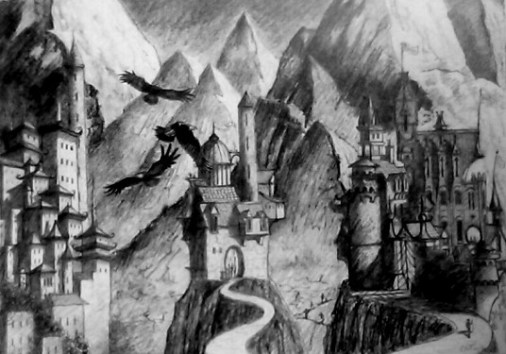
When we reached Salamanca, we visited the Taberna Celta and met the owner Caesar whose hospitality and generosity is legendary. Apart from the glorious food and wine, he entertained us with stories of the history of the Caminos. He told us that the ancient Celts starting walking the Caminos in pre-Roman Iberia. They followed ley lines, lines of energy, not to Santiago de Compostela, but to Finisterre, Spanish for the end of the world.
 They made these journeys, not out of necessity, but to examine and explore their concept of reality. They walked to the very edge of what they thought was a flat earth and peered over the edge into the abyss. They watched their sun-god disappear into oblivion, in the west, every evening and then reappear, in the east, next morning. That must have been an exceptional reality trip.
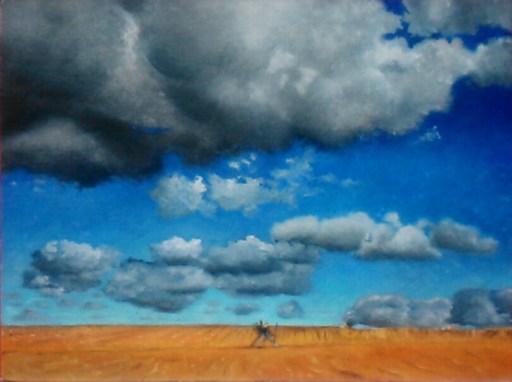
We left Salamanca and set off across the Meseta. The Spanish Meseta covers 210,000 square kilometres and has an average elevation of 660 metres. In other words, it is vast, it is incomprehensible, it is another world. After a few days walking under those enormous skies, you very slowly realise that reality has become a mere concept and, no longer, are there any hard and fast rules. You can walk to the very limit of your life experience and, like the ancient Celts, peer over the edge into the abyss and see what you find there.
This is a painting from my forthcoming exhibition of paintings and drawings. It is a watercolour on paper, 77×57 centimetres (framed) and is called ” The Ventriloquist’s Do…
Source: The Ventriloquist’s Doll

“The Ventriloquist’s Doll”
This is a painting from my forthcoming exhibition of paintings and drawings. It is a watercolour on paper, 77×57 centimetres (framed) and is called ” The Ventriloquist’s Doll”. The images in the exhibition have been inspired by a 1000 kilometres walk, called the Via de Plata, I completed in Spain this year. You may ask what a ventriloquist’s doll has to do with a 1000 kilometres walk, so, for an answer, read on.
The image talks about the influence parents have on creating a reality for their children and how deeply it becomes ingrained in their subconscious and how much it controls their adult life.
It is a self-portrait and shows me as a ventriloquist’s doll. When I was growing up, I always felt that somebody else was pulling the strings. I am a child of the 50’s and at that time there was a craze for wallpaper. It was seen as a symbol of progress, change and modernity. In the inset, my parents are hanging wallpaper inside my head to create both a reality and their life plan for me.
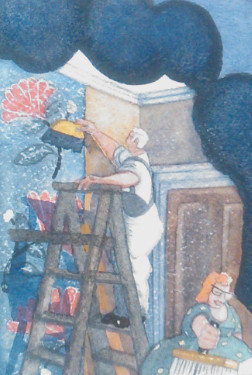
Inset
One of the great benefits of long distance walks such as the Caminos in Spain, of which the Via de Plata is only one of many, is that they lead you into such strange and interesting places. Provided you are prepared to leave the paraphernalia of everyday life behind, you will eventually find yourself standing outside what you have always accepted as reality, looking in.
The exhibition opens on Thursday 1 December 2016, at 7pm, in Cultúrlann McAdam Ó Fiaich, 216 Falls Road, Belfast BT12 6AH
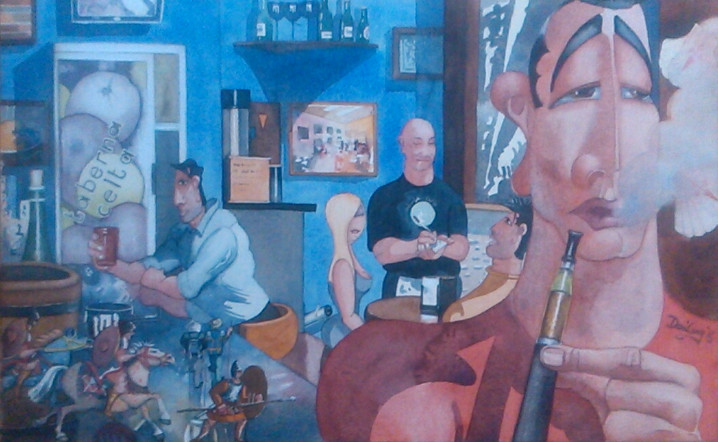
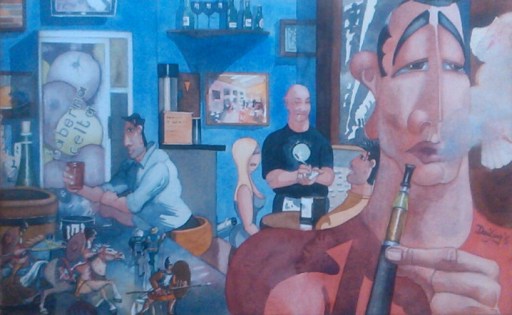
This is a painting from my forthcoming exhibition. The images were inspired by a 1000 kilometre walk I made in Spain this year, 2016, from Seville, in the south, to Santiago de Compostela, in the north. It is a watercolour on paper, 37×54 centimetres and called ‘ In the Taberna Celta, Salamanca’.
Salamanca is an ancient, monumental, university city with a touch of magic woven into its fabric. Victor and I booked into the very friendly municipal hostel and on our first afternoon exploring the city we drifted inexorably towards the renowned Taberna Celta. The Taberna Celta is a small bar and restaurant near the cathedral and also a mecca, a meeting point and a must visit for all pilgrims walking the Via de Plata. The owner Caesar is notorious for his almost life threatening generosity and hospitality.
We spent a glorious afternoon not only being plied with wonderful food and wine but also being regaled, by Caesar and his friends, with stories of Salamanca and the Camino. According to Caesar, during the last ice age, the ice advanced as far as the Pyrenees. Hence, most of the people of northern Europe moved south in advance of the glaciers and eventually came to live on the Iberian peninsula bringing with them their ancient magic and wisdom.
The Celts or Celtiberians, who occupied most of the peninsula in the final centuries BC, started walking Caminos along lines of energy, ley lines, not to Santiago de Compostela but to Cape Finisterre (the end of the known world), to worship the sun-god. Where the ley lines intersected were important hot spots of energy and the Celtiberians marked them with temples and later cities, such as Salamanca. The Romans realised the importance of ley lines and built their roads along them. The energy in the earth ionises the air above it, giving energy to marching soldiers. The Via de Plata follows exactly the original Roman road. During the second world war, the Germans visited the cave system behind Salamanca to investigate rumoured ancient sources of energy. Unfortunately, for whatever reason, they failed to publish their findings and, in spite of our enthusiasm, we were quietly dissuaded from attempting a visit the caves.
We spent the next couple of days examining every nook and cranny in the city. Having walked across the vast Meseta for weeks, reality had become a concept rather than a fact. We felt that we were just touching the surface of something very intriguing, yet another reality, something very special but it wasn’t ready to let us in.
The painting shows the interior of Taberna Celta, with the customers as I remember them and Caesar as the waiter. However, in the foreground, two pilgrims stride along the counter, accompanied by a group of Celtiberians. The exhibition will open on Thursday 1 December 2016, in the Cultúrlann McAdam Ó Fiaich, 216 Falls Road, Belfast.
This is a painting from my forthcoming exhibition. The images were inspired by a 1000 kilometre walk I made in Spain this year, 2016, from Seville, in the south, to Santiago de Compostela, in the…
This is a painting from my forthcoming exhibition. The images were inspired by a 1000 kilometre walk I made in Spain this year, 2016, from Seville, in the south, to Santiago de Compostela, in the north. It is a watercolour on paper, 37×54 centimetres and called ‘ In the Taberna Celta, Salamanca’.
Salamanca is an ancient, monumental, university city with a touch of magic woven into its fabric. Victor and I booked into the very friendly municipal hostel and on our first afternoon exploring the city we drifted inexorably towards the renowned Taberna Celta. The Taberna Celta is a small bar and restaurant near the cathedral and also a mecca, a meeting point and a must visit for all pilgrims walking the Via de Plata. The owner Caesar is notorious for his almost life threatening generosity and hospitality.
We spent a glorious afternoon not only being plied with wonderful food and wine but also being regaled, by Caesar and his friends, with stories of Salamanca and the Camino. According to Caesar, during the last ice age, the ice advanced as far as the Pyrenees. Hence, most of the people of northern Europe moved south in advance of the glaciers and eventually came to live on the Iberian peninsula bringing with them their ancient magic and wisdom.
The Celts or Celtiberians, who occupied most of the peninsula in the final centuries BC, started walking Caminos along lines of energy, ley lines, not to Santiago de Compostela but to Cape Finisterre (the end of the known world), to worship the sun-god. Where the ley lines intersected were important hot spots of energy and the Celtiberians marked them with temples and later cities, such as Salamanca. The Romans realised the importance of ley lines and built their roads along them. The energy in the earth ionises the air above it, giving energy to marching soldiers. The Via de Plata follows exactly the original Roman road. During the second world war, the Germans visited the cave system behind Salamanca to investigate rumoured ancient sources of energy. Unfortunately, for whatever reason, they failed to publish their findings and, in spite of our enthusiasm, we were quietly dissuaded from attempting a visit the caves.
We spent the next couple of days examining every nook and cranny in the city. Having walked across the vast Meseta for weeks, reality had become a concept rather than a fact. We felt that we were just touching the surface of something very intriguing, yet another reality, something very special but it wasn’t ready to let us in.
The painting shows the interior of Taberna Celta, with the customers as I remember them and Caesar as the waiter. However, in the foreground, two pilgrims stride along the counter, accompanied by a group of Celtiberians. The exhibition will open on Thursday 1 December 2016, in the Cultúrlann McAdam Ó Fiaich, 216 Falls Road, Belfast.
 dandowlingblog