This is a drawing from my forthcoming exhibition to be held in the Cultúrlann, Belfast. The inspiration comes from a 1000 kilometer walk, from Seville, in southern Spain, to Santiago de Compostela…
Source: Manolo and the Ancestors
This is a drawing from my forthcoming exhibition to be held in the Cultúrlann, Belfast. The inspiration comes from a 1000 kilometer walk, from Seville, in southern Spain, to Santiago de Compostela…
Source: Manolo and the Ancestors
This is a drawing from my forthcoming exhibition to be held in the Cultúrlann, Belfast. The inspiration comes from a 1000 kilometer walk, from Seville, in southern Spain, to Santiago de Compostela, in northern Spain, completed by me this year, 2016. It is pencil on paper, 57 X 33 centimeters and called “Manolo and the Ancestors”.

I first met Manolo in Fuenterroble de Salvatierra. Fuenterroble is a small village with a population of 296 people. It has a slightly surreal appearance in that it looks like it has been dropped randomly in the vast expanse of the Spanish Meseta.
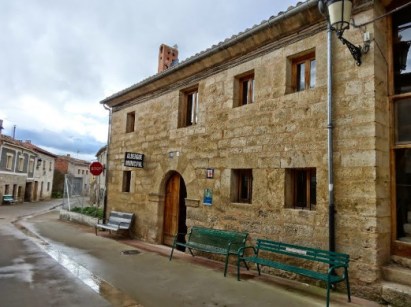 It consists of a few streets of houses huddled together against the elements. Padre Blas runs the hostel for pilgrims. I had intended to visit him as he is renowned for his many years of work both promoting and maintaining the Camino and is something of a Camino legend. I was beginning to realize that there was more to this experience than just walking and I was hoping to catch a few pearls of inspiration from this much ballyhooed wise man.
The hostel is at the far end of the village. It has a distinct low set appearance and the interior, in common with most houses in this area, is very dark, 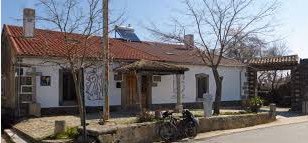 with lots of wooden beams, heavy stone walls and a huge log fire burning in an open-hearth in the main room. The doors were open, I wandered in but the place seemed to be empty. I was about to leave when a voice called me back. This was Manolo.
Manolo not only introduced himself but continued talking, in what could only be described as a stream of consciousness, describing his family background, going back several generations, in great detail. I found this very strange behavior, to say the least. However, it was later explained to me that he had grown up in a very small village of thirty people. Back in the day, before travel was common and the gene pool was limited, it was very important to know your genealogy. It appeared that Manolo was still living back in the day. Padre Blas eventually joined us. He was friendly and welcoming but the ‘spirit of the Camino’ is getting on in years and rather than being the hoped-for source of inspiration, was content to allowed Manolo the floor.
It turned out to be a very enjoyable and interesting afternoon. I was given a glimpse into another reality, so very different to my own and I felt that I had to record it. Manolo not only lived in a world where several generations of ancestors influenced and advised him on his everyday life but also he had no concept and even less interest in modern-day technology. Hence, I have shown him wearing his clockwork thinking cap and with the odd small figure tinkering with the mechanism to ensure smooth running.
The exhibition will open on Thursday 1 December in the Cultúrlann, Falls Road, Belfast.
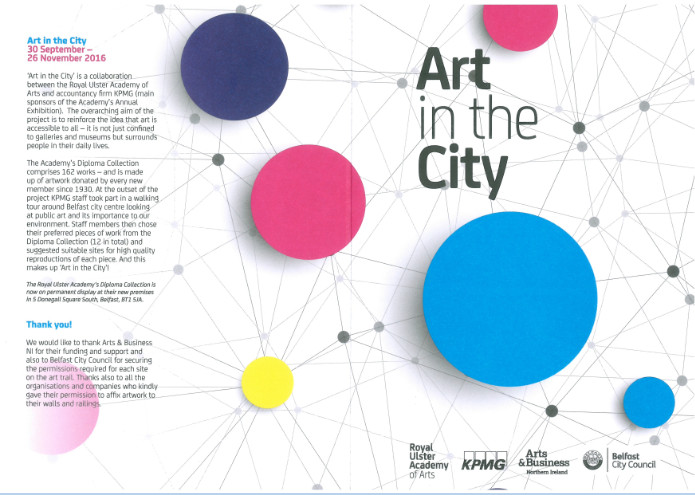
There is a new art trail in Belfast. Many of the pieces have an interesting connection to their location. My own painting called “Big Daddy’s Funeral” has been placed at Saint Pat…
Source: Art in the City
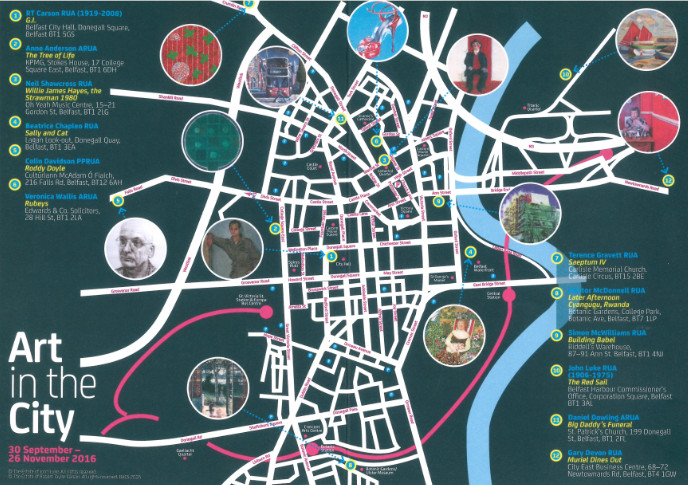
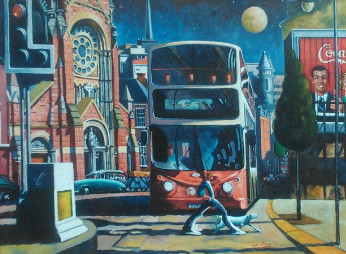
There is a new art trail in Belfast. Many of the pieces have an interesting connection to their location. My own painting called “Big Daddy’s Funeral” has been placed at Saint Patrick’s Chapel in Donegal Street and, I hope, the connection is obvious. So, look out for the paintings and enjoy the trail. It will be in place until the 26 November 2016.
This is an easy, to moderate, 15.8 kilometers, circular walk on quiet tarmac roads and lovely old grassy tracks. It will not only take you on a ramble through both ancient and contemporary Irish history but a…
Source: Legananny Dolmen Circuit
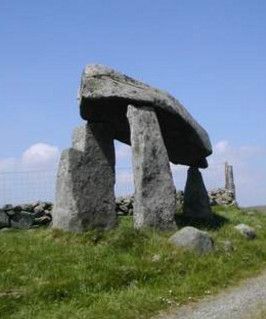
This is an easy, to moderate, 15.8 kilometers, circular walk on quiet tarmac roads and lovely old grassy tracks. It will not only take you on a ramble through both ancient and contemporary Irish history but also give you excellent views of the Mountains of Mourne. For more information, a map and statistics go to http://www.wikiloc.com/wikiloc/view.do?id=15111961
To reach the dolmen, drive straight through the village of Dromara and then the next village Finnis. Shortly after Finnis, you will pick up signs for Legananny Dolmen and Souterrain. There is a small car park beside the Dolmen. It is a very elegant structure and well furnished with information signs. The exact purpose behind its construction has been lost the mists of time. However, it is thought that the people who built it realized that countless generations had passed before them without leaving a trace of their existence. They, not only wanted to make their mark in time but also to time travel into the future and say to future generations, we were here and we were clever and sophisticated people.
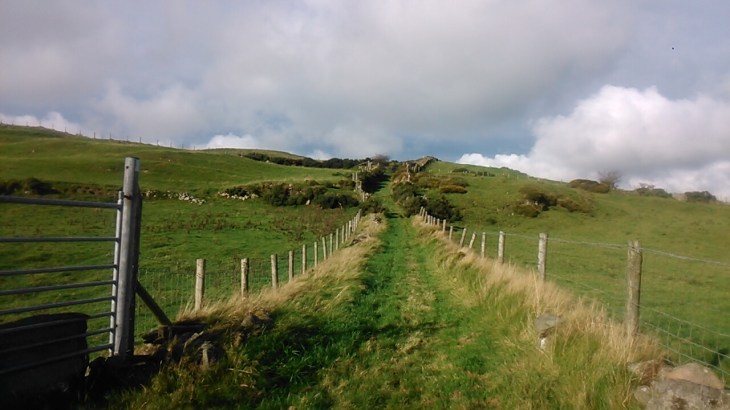
From the Dolmen, walk back the way you drove in and at the top of the hill, you will see a wooden sign marked Footpath. Take this, keeping right at the fork, and it will lead you to the Slievenaboley Road. Turn left to the car park and viewpoint. Here you will get excellent views of the Mountains of Mourne, Slieve Croob, the Belfast Hills and,on a clear day, the Sperrins.
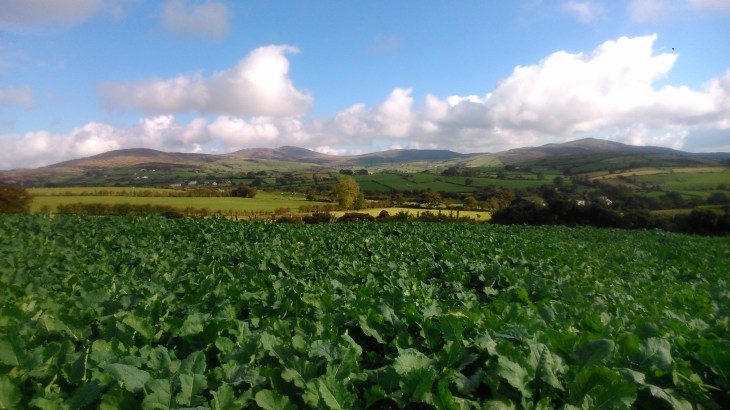
Follow the road downhill and then turn right along Lighthouse Road. At the top of the hill, take a right along a path marked Moat Pad Footpath. Follow the yellow arrows , keeping left. “Moat” refers to several ringforts or raths, to be found at the end of the track. Look out for a gate on the right and take the track at first going up a hill and then down through a farm-yard. The farmer is very friendly and always happy to stop for a chat. Red kites are frequently seen in this area. Were the farm track reaches the tarmac road, look in the fields directly in front and to the left and you will see two large raths or ringforts, encircled with trees.
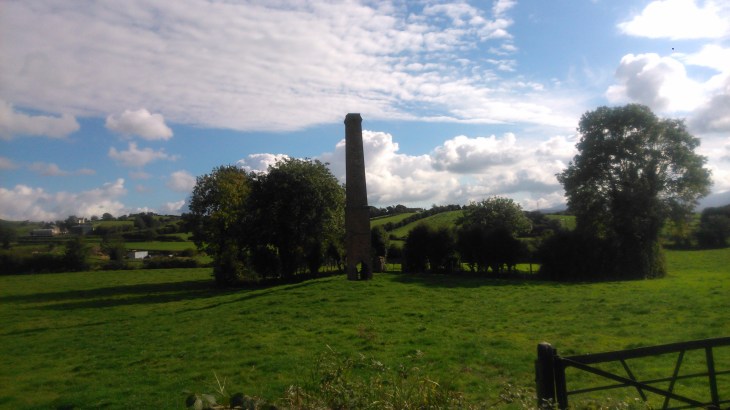
Go left on the tarmac road and this will quickly bring you into the village of Dechomet. There is some debate as to the origin of the name Dechomet but it is thought to come from the Irish Deas Coimhéad – good look-out post/good prospect. Walk straight through the village and you will come to something remarkable. In a field on the left, you will see a substantial red brick chimney, with a rath behind enclosing an ancient circular graveyard. The story goes that the chimney was the beginning of a linen factory. The gravestones were removed prior to preparing the ground for the factory. The linen industry collapsed almost overnight under the pressure from cheap imports and work stopped on the factory. No record had been kept of the original positions of the gravestones, so rather than replace them with the wrong owner, they were placed in a circle at the edge of the rath.
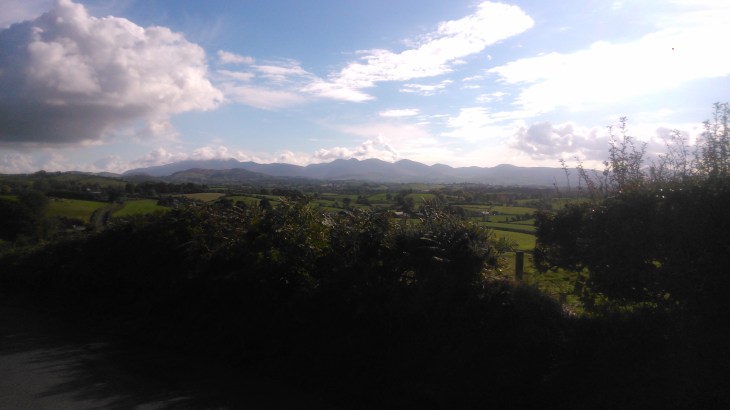
From here, return to the village where Turley’s Bar is worth a visit. Now, take the Ballymacilreiny Road. This road undulates through low farmland passing Derryneil Baptist Church. When you reach the T-junction with the Millvale Road, go left and within 100 meters, turn left again on Adder’s Loanin Footpath. Follow this beautiful old grassy track past some ruined cottages, through another farmyard and you will eventually come back full circle to Lighthouse Road. Retrace your steps going left along Lighthouse Road. At the T-junction go left and then sharply right, climbing up Legananny Hall Road. When you come to the Orange Hall go sharp left and this will bring you back to the dolmen and the car park.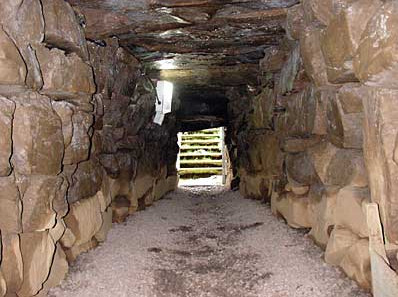
The souterrain is also worth a visit. It is well signposted with plenty of information. It dates from the 5th century and when you are in the passageway or one of the chambers, place your hand on any of the stones and there is a very good chance that the last person to touch that particular stone lived in the 5th century.
This is a painting from my forthcoming exhibition, it is called “Dreaming of Tartessos”, it is oil on canvas and 50×70 centimeters. It, together with all the other images, was insp…
Source: Dreaming of Tartessos
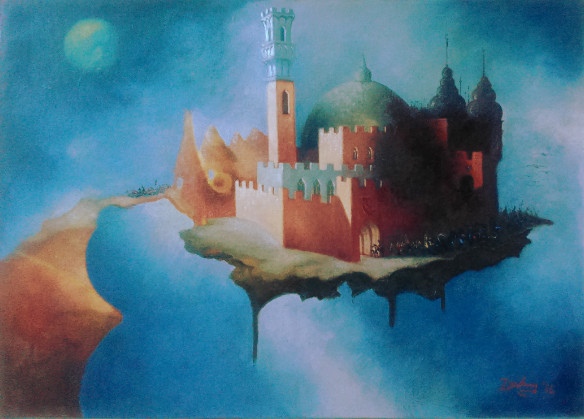
This is a painting from my forthcoming exhibition, it is called “Dreaming of Tartessos”, it is oil on canvas and 50×70 centimeters. It, together with all the other images, was inspired by a 1000 kilometers pilgrimage walk I made in Spain this year, from Seville in the south to Santiago de Compostela in the north. The original idea behind the project was to make Celtic/Spanish connections and, of course, the ancient Celtic city or kingdom of Tartessos was never far from my mind.
Tartessos was once thought to be a myth but in the light of more recent evidence is slowly emerging into reality. It was a fabulously rich region in the extreme southwest of the Iberian peninsula. Of most interest to me is the theory that Tartessos and the language spoken, Tartessian, was partly or wholly Celtic. In fact, John Koch in his article in History Ireland suggests that Tartessian is ‘more than a little bit Celtic’ and adds a new twist to the assertion, long since dismissed as invention, that the Gaels (Milesians) originated in the Iberian Peninsula. For more information on this and much more go to http://www.historyireland.com/pre-history-archaeology/tartessian-europes-newest-and-oldest-celtic-language/
But, how best to depict Tartessos? I see it as an ancient city with hoards of travelers and traders constantly passing through its gates but also, with all it represents, a thought or an idea hanging in the mists of time.
The exhibition will open on Thursday 1 December, in the Cultúrlann, Falls Road, Belfast.
This is one of four drawings which will be shown at my forthcoming exhibition in December 2016. The exhibition will be based on my experiences on walking the 1000 kilometres long Via de Plata from…
Source: Where Eagles Fly
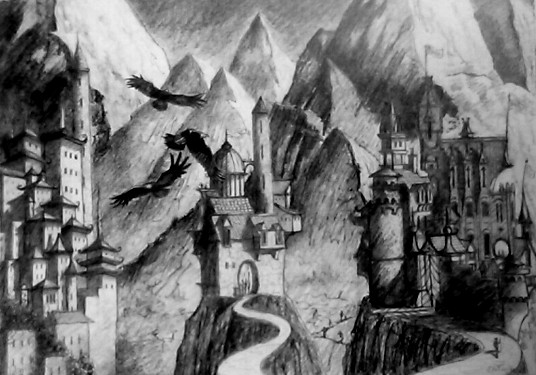
This is one of four drawings which will be shown at my forthcoming exhibition in December 2016. The exhibition will be based on my experiences on walking the 1000 kilometres long Via de Plata from Seville in southern Spain to Santiago de Compostela in the north. My previous blogs are available at the bottom of the home page on my website http://www.dandowling-artist.com
One of my initial ideas on undertaking this journey was to investigate ancient Celtic/Spanish connections. I was especially interested in the fabulously rich, pre-Roman, Celtic city of Tartessos. Tartessos was once thought to be a myth but the myth is slowly merging into reality. For more information go to John Koch’s article http://www.historyireland.com/pre-history-archaeology/tartessian-europes-newest-and-oldest-celtic-language/ in which he suggests that Tartessian is ‘more than a little bit Celtic’ and adds a new twist to the assertion, long since dismissed as invention, that the Gaels (Milesians) originated in the Iberian Peninsula.
In Extremadura, Tartessos is accepted as a historical fact and, frequently mentioned, are three villages located in a very remote valley, in the northwestern part of the province, where, it is said, the remnants of the Tartessian language is still spoken. The language is called Fala. The three villages are nor only remote from both Spain and Portugal but so remote from each other that three distinct dialects have emerged although they are mutually intelligible with each other.
San Martín de Trevejo is the smallest of the three, with a population of 926 people and their dialect of Fala is called “Manhegu”. Eljas has a population of 1046 who speak “Lagarteiru” and in Valverde del Fresno with a population of 2576 they speak “Valverdeiru”. I managed to visit San Martín de Trevejo and listened to the Fala language. Was I listening to a version of ancient Tartessian and according to John Koch, Irish? It was interesting, to say the least. However, even more, intriguing is the fact that the Fala language whilst unrelated to modern-day Spanish or Portuguese has always been mutually intelligible with Galician. Just think of the Milesian ( modern-day Galicia) invasion of Ireland, as recorded in “Leabhar Gabhála na hÉireann”. It is difficult not to draw conclusions.
https://en.wikipedia.org/wiki/Lebor_Gab%C3%A1la_%C3%89renn
The drawing shows the three villages, very much on a “once upon a time” theme, high in the mountains where the eagles fly. The exhibition will open on Thursday 1 December 2016, in the Cultúrlann, Falls Road, Belfast.
 dandowlingblog