This is a beautiful 14 kilometres walk along forest tracks and old traffic free roads, although there is one rough muddy section which necessitates boots rather than shoes. The walk is very well m…
Source: Barnavave Loop
This is a beautiful 14 kilometres walk along forest tracks and old traffic free roads, although there is one rough muddy section which necessitates boots rather than shoes. The walk is very well m…
Source: Barnavave Loop
This is a beautiful 14 kilometres walk along forest tracks and old traffic free roads, although there is one rough muddy section which necessitates boots rather than shoes. The walk is very well marked with the red arrows but for a map, more information and photographs go to http://www.wikiloc.com/wikiloc/view.do?id=13732618
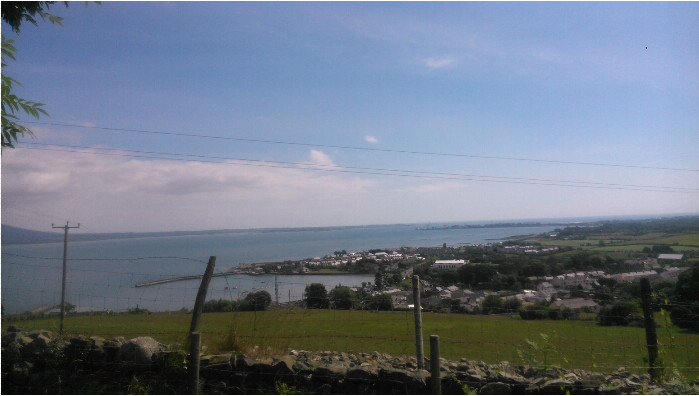
It starts in the square in Carlingford Village, climbs up the hill and then turns right along a forest track where you can enjoy wonderful views of Carlingford Lough. At the stile, it turns left and then handrails the fence above the forest. This is the rough part but it can be negotiated with care.
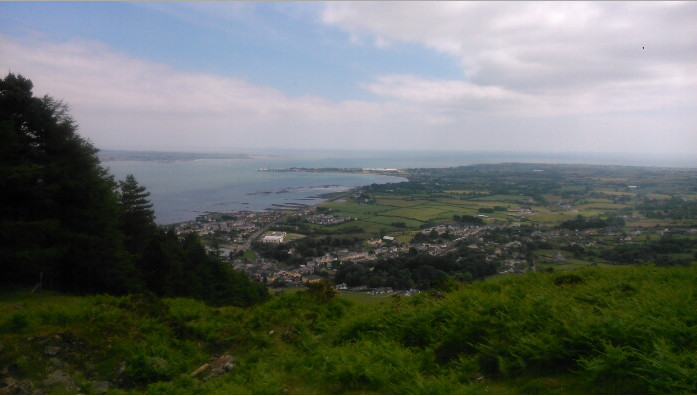
After approximately 6 kilometres, the landscape opens up again to give excellent views of Carlingford, Slieve Foye, and Barnavave and the track improves to a broad grassy path.
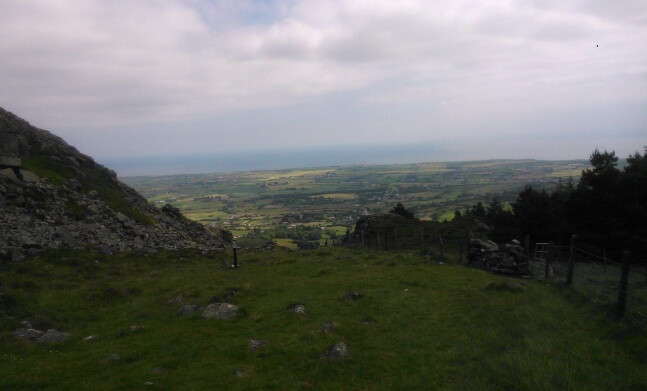
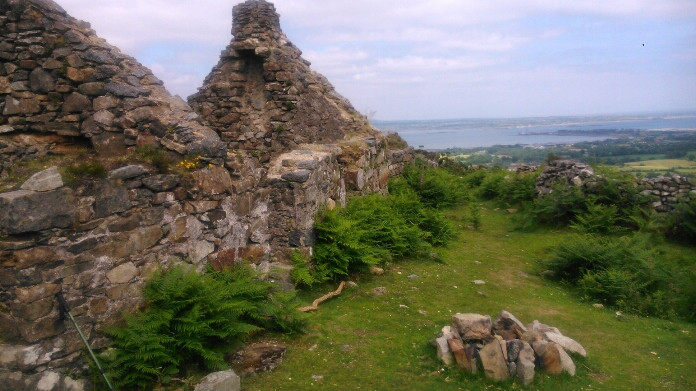
This will take you to Maeve’s Gap and then downhill to a deserted village. From here, a stile gives access to a series of old roads which will bring you back to Carlingford.
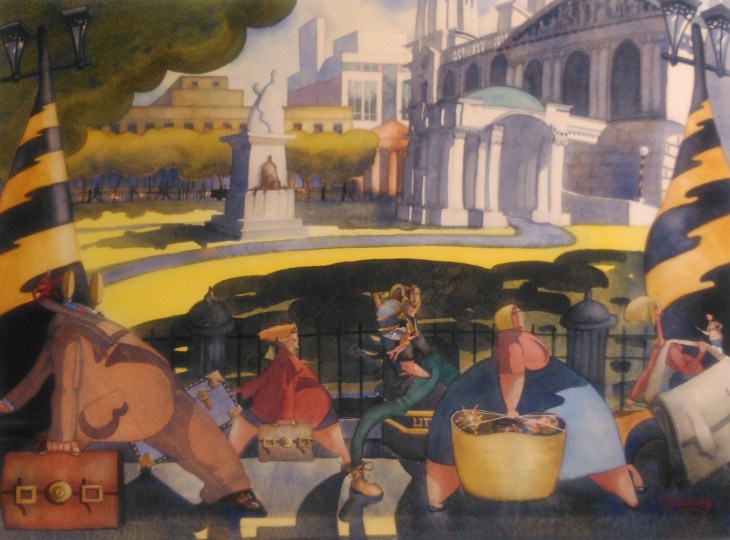
This is a painting called “Bagáiste” (Baggage) . It is watercolour on paper, 50×70 centimetres. The inspiration comes from my recent Camino in Spain even though the scene in the background is taken from a much earlier work and shows Donegall Square and the City Hall. I thought that it was important to bring the Camino and my French friend Victor, he with the rucksack, to Belfast.
As a metaphorical image, emotional baggage can be defined as the carrying of all the disappointments, wrongs, and trauma of the past around with one in a heavy load. We all carry it to a lesser or greater extent. However, the independence, self-reliance and total detachment from our everyday lives that we can achieve on experiences such as Caminos, gives us the ability to not only become aware of but also to dump same in the recycling where it belongs.
The painting shows two faceless men ( I seem to be getting very fond of them but there are a lot around these days) with a devil on their shoulders. A prime business type trailing her baggage, neatly secured under lock and key, a huge lady carrying the things of childhood in a large old brown paper bag and a twenty-something still being lectured by a ghost from the past. And there is Victor.
Yesterday we visited the Brú na Bóinne complex in county Meath, an excellent and highly recommended experience. The Brú na Bóinne complex consists of three main structures, Newgrange, Knowt…
Source: Time Surfing at Brú na Bóinne
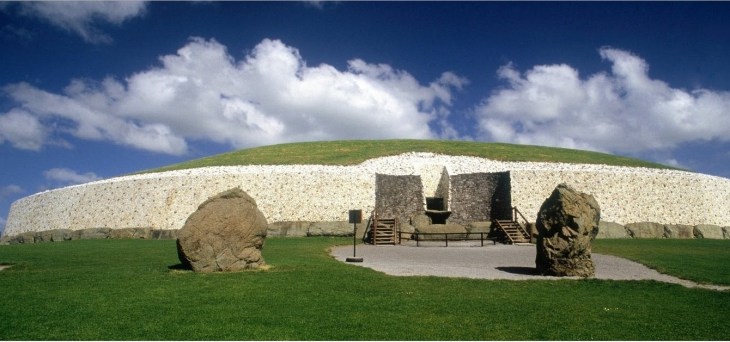
Yesterday we visited the Brú na Bóinne complex in county Meath, an excellent and highly recommended experience.
The Brú na Bóinne complex consists of three main structures, Newgrange, Knowth and Dowth together with a plethora of satellite tombs. It is an enigma wrapped in a conundrum. How was it built? This is a magnificent feat of construction and engineering, built before the invention of the wheel and metal tools. Why was it built? Speculation abounds ( aliens not excluded).
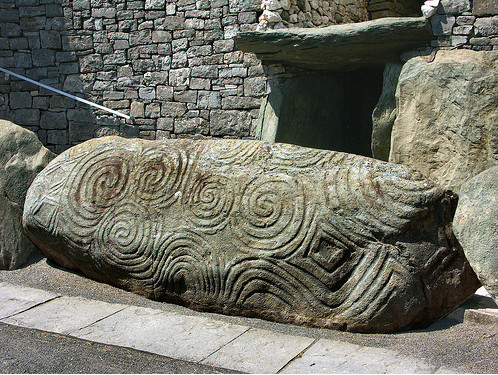
The three main structures have been accurately dated to between c. 3200 and 3100 BC. This makes them five hundred years older than the current form of Stonehenge and the Great Pyramid of Giza in Egypt , as well as predating the Mycenaean culture of ancient Greece. They have each been, very accurately, aligned with the rising or setting sun at different solstices.
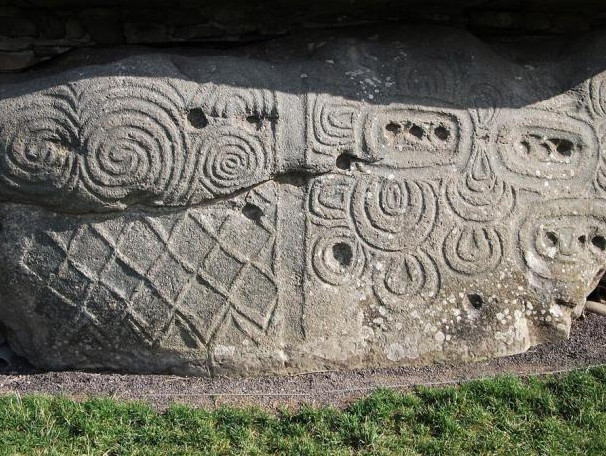
We started at Knowth and admired the many examples of, what is said to be abstract Neolithic rock art. However, whether or not there is meaning in these swirls, chevrons and lozenges, has been lost in the mists of time and, I think, is even beyond speculation.
I found Newgrange more accessible. You enter through a narrow nineteen metres long passageway which ascends about a metre to reach the central chamber. However, once you reach that small corbelled space, you realise that you have not only walked nineteen metres but also travelled back in time, five thousand years. What you are seeing and feeling is exactly what our Neolithic ancestors experienced.
Most monuments record past glories, but the people who built Newgrange were not only sun worshipers they also wanted to communicate with future generations, they were time surfers. The structure is aligned with the rising sun at the solstice, at midwinter, at the time of the shortest day, around the 22nd December . At this date and for a few days on either side the rising sun floods along the passageway and lights up the central chamber for a brief seventeen minutes.
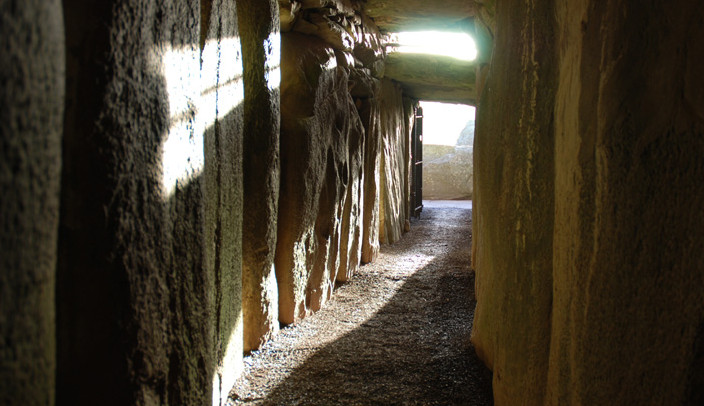
For those not lucky enough to be there, the effect can now be created artificially. The chamber is plunged into darkness and the artificial sun god starts his journey along the passageway. It has a gentle hypnotic effect and you become very much aware that you are not only standing in the place of those Neolithic people on that very first midwinter morning five thousand years ago but also in that of future generations, five thousand years and millennia to come.
The concept of long periods of time is a difficult one for our human brain to conceive, we tend to think in terms of our own life span. However, the light will continue to flood in every midwinter morning as long as there is a sun to shine and, maybe, long after there is anyone left to enjoy it.
 dandowlingblog