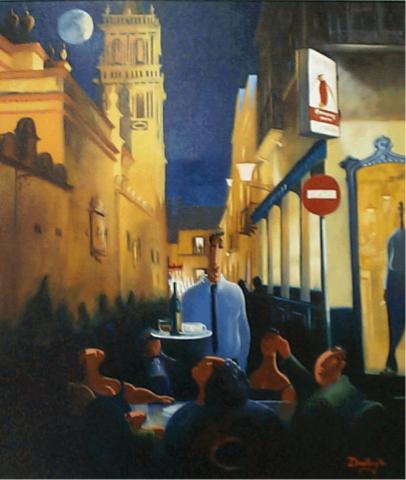
“Sunday Night in the Triana, Seville” http://www.dandowling-artist.com
Have you ever felt a little bit Spanish? Does your pulse race to the rhythmic click of the castanets? Does your pacemaker skip a beat at the strum of the Flamenco guitar? It could be the emotional memory of long sunny days on the Costas or the echo of an ill-considered tapa, eaten in haste and digested in regret. However, if you consider yourself a Celt, a possibly fictional, but nonetheless, much-loved people, then could it be something in the genes?
John Koch makes much of this in his article (http://www.historyireland.com/pre-history-archaeology/tartessian-europes-newest-and-oldest-celtic-language/). He states that there is more than sufficient evidence to suggest that the Gaels or Celts originated in the Iberian Peninsula, in particular, in a place of immense natural wealth in silver and gold, called Tartessos. It is thought to have been situated in Europe’s south-west, beyond the Pillars of Hercules or possibly in a triangle between Malaga, Seville and Cadiz. Koch has found tantalising connections between the spoken language, Tartessian, and ancient Celtic and contemporary Irish. For example, in 550 BC the fabulously rich ruler of Tartessos was called Arganthonios (literally man of silver). In his name we can recognise the modern Irish word for silver, airgead, and the ancient Celtic word for silver, arganto.
The Leabhar Gabhála Na hÉireann (the Book of Invasions) https://en.wikipedia.org/wiki/Lebor_Gab%C3%A1la_%C3%89renn lists six conquests of Ireland culminating with that of the Milesians otherwise known as the Gaels or Celts. At that time, Ireland was, and had been for 150 years, occupied and successfully ruled by the Tuatha Dé Danann. The Tuatha Dé Danann were, and are, a supernaturally gifted and very cool people who favoured dark clouds as a means of transport. Nevertheless, after much to do, they conceded that the Gaels should take the above world in Ireland, and they, the Tuatha Dé Danann, that below (the other world), an agreement which has been honoured to this very day.
You will know from reading my previous blog, that I intend to walk the Via de Plata, an ancient route of some1000 kilometres, from Seville to Santiago de Compostela. This will be a personal voyage of discovery. I will be walking, blogging, and sketching. I intend to visit as many Tartessian and Celtic sites as possible. However, I do not expect to find any wild-eyed, Irish-speaking, tribes in the more remote parts of Extremadura but, maybe, some more intangible cultural connections. The word tio means uncle in Spanish but it is also used as a term of endearment between very old friends. If the Leabhar Gabhála Na hÉireann is anything to go by then, surly, the Irish and the Spanish share more than an uncle or two.
http://www.dandowling-artist.com
 dandowlingblog
[…] Walking with my Spanish Uncles […]
LikeLike